
Global Privacy Platform (GPP) & What It Means for Cookie Consent

Summary
Readers will discover the mechanisms by which GPP operates behind the scenes, why GPP reduces the technical complexity of consent management, and why GPP improves compliance while protecting cookie banners and user choices.
With the changing global privacy regulations, managing different consent signals for every region is a headache.
To tackle this challenge, the IAB Tech Lab has developed the Global Privacy Platform (GPP), which is a centralized way of standardizing how websites, advertisers, and platforms communicate user privacy preferences and respect the user.
Let’s jump into what Global Privacy Platform (GPP) is, why it matters, and cookie consent implications.
What is the Global Privacy Platform (GPP)

The Global Privacy Platform (GPP) is essentially a common vocabulary for user privacy preferences across jurisdictions. IAB Tech Lab specifically created GPP for the major purpose of simplifying how websites communicate user privacy preferences in various countries and states.
Different regions of the world have different privacy regimes today. In Europe, people refer to the privacy law as GDPR, while in California, it is known as CCPA or CPRA.
Websites would have had to manage multiple different consent frameworks. An example of these regulatory regimes would be:
| Region | Framework | Purpose |
| European Union (EU) | TCF (Transparency & Consent Framework) | Administer consent for advertising, as required by the EU GDPR |
| United States | USP v1 / USP v2 | Monitor opt-out rights as required by CCPA/ CPRA |
| Canada | TCF Canada | Govern consent transparency requirement for Canadian privacy law |
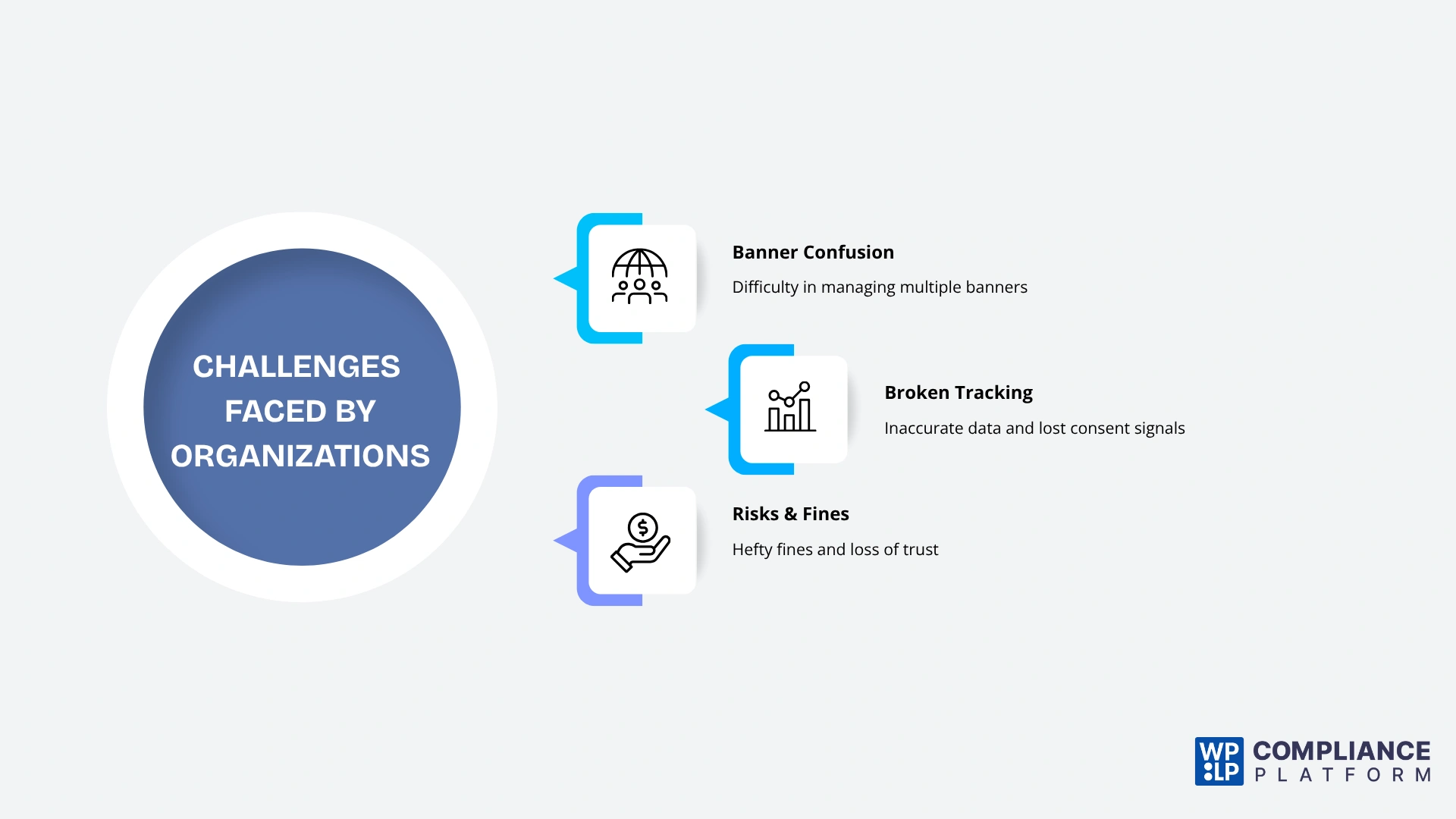
Each region has its own privacy consent frameworks, and each framework has its own rules, categories and signaling formats. Since they aren’t aligned, organizations have to operate in a number of overlapping frameworks at the same time. This leads to complications while complying with these privacy regulations and can also cause other concerns:
- Creating different banners for different regions based on their privacy laws leads to confusion and management difficulties.
- Broken consent tracking with analytics tools and ad networks.
- Accidentally breaking any privacy law, which can then lead to hefty fines and loss of trust among users.
GPP provides a cooperative set of frameworks. For businesses, GPP is:
- Single standardized signal: GPP is a single, mutually agreed upon set of data representing a user’s privacy preferences.
- Single integration: No longer having to integrate with different structures for different regions/vendors, a site or CMP can integrate that data just once with GPP.
- It sends the user’s consent choices into a machine-readable signal that vendors can consume.
GPP has been developed in a manner that it simplifies the meaning behind consent categories that are used to address ads, analytics, personalization, measurement, sale/sharing, etc.
Why GPP Matters
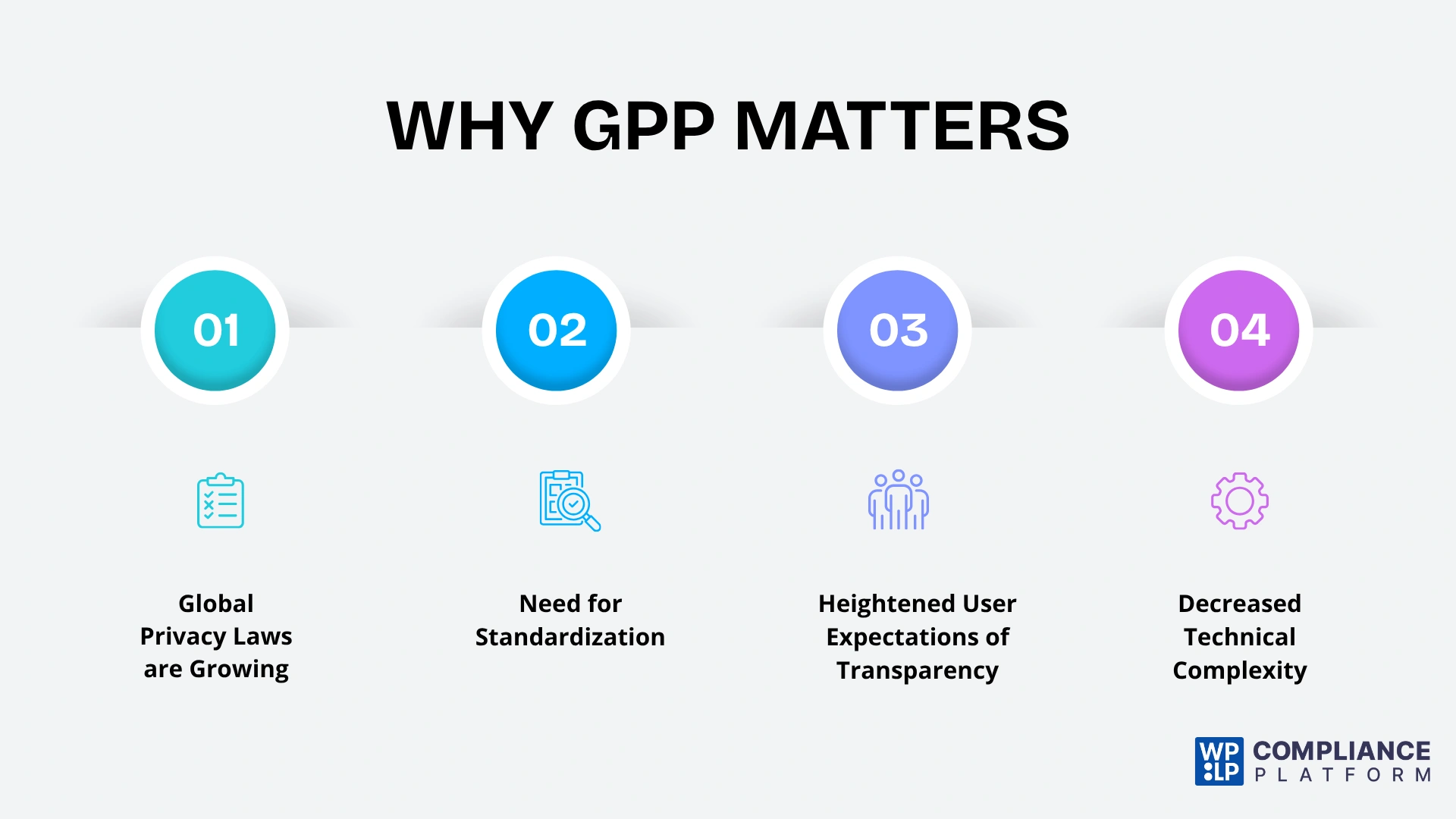
Privacy regulations keep evolving with time across the globe, hence, it demands a more effective way to collect user consent in different regions worldwide. To solve this recurring issue, GPP has been put forward as a standardized method of expressing privacy preferences.
Here is why it matters:
Global Privacy Laws Are Growing: New laws are still emerging from the EU, certain U.S. states, Canada, and more, and each has its own consent requirements.
Need for Standardization: Without GPP, a website will need to manage multiple consent logics for various regions. GPP takes that and puts it all in one format that works anywhere.
Heightened User Expectations of Transparency: As users are increasingly more aware of their rights, they want to know how their data is collected, stored, and shared. GPP helps to provide this important consistency in honoring their choices.
Decreased Technical Complexity: Instead of having to set up multiple scripts and multiple banners, GPP creates much less technical complexity, such that fewer sets of code will be needed, adjusting across ad stacks, analytics tools, and CMPs.
GPP does all of this while making compliance easier, clearer, and more dependable for both businesses and users.
How Does GPP Impact Businesses
GPP alters how websites manage user data across marketing, analytics, and advertising tools. Rather than having each platform interpret consent independently, GPP acts as one single common signal that all platforms will be able to understand.
1. Tools Only Run Once the User Gives Their Consent
When GPP is enabled, tools such as Google Analytics, Meta Pixel, and ad networks will only run after the user provides consent for tracking. Consent Mode v2 is already in place to modify how Google collects data from the user based on their consent decision.
GPP enhances this by transmitting the same consent signals that the user provides to all platforms. This integrated and compliant tracking experience requires no additional work.
2. Personalized Ads Retain User Choice
Remarketing and behavior-based advertising rely on the tracking of user activity. Before GPP, opting out of tracking was not universal across different tools. After GPP, opting out automatically applies uniformly to all tools.
- If the user opts out, personalized ads and remarketing are disabled.
- If the user opts in, the campaigns will run fine with no manual intervention.
3. Consistent Consent Across Platforms
Formerly, consent signals have been interpreted differently on various platforms, which has led to inconsistent data across those platforms. GPP addresses the inconsistent consent across platforms by offering a single consent signal, which takes the miscommunication out of the equation and provides the same consent rule across every tool.
4. One Implementation for Many Privacy Laws
Privacy regulations can vary by region. Without GPP in place, a website would have to set up a different consent system for every region. GPP allows you to put in place a single consent for every region, but, as before, region-specific legal rules will have to be implemented, like an explicit opt-in in the EU.
GPP also enables the use of consent management, allowing businesses to respect user privacy while using applicable analytics and ad workflows.
Standardizing consent sharing across platforms simplifies the process even more. So that it can minimize cross-platform miscommunication and continue complying with privacy regulations around the globe.
How to Implement GPP on Your Website
As the world sees a surge in privacy regulations, businesses require an effective way to share user consent preferences across regions. The Global Privacy Platform (GPP) provides a foundation for how consent data will be shared with ad networks, analytics platforms, and third-party tools.
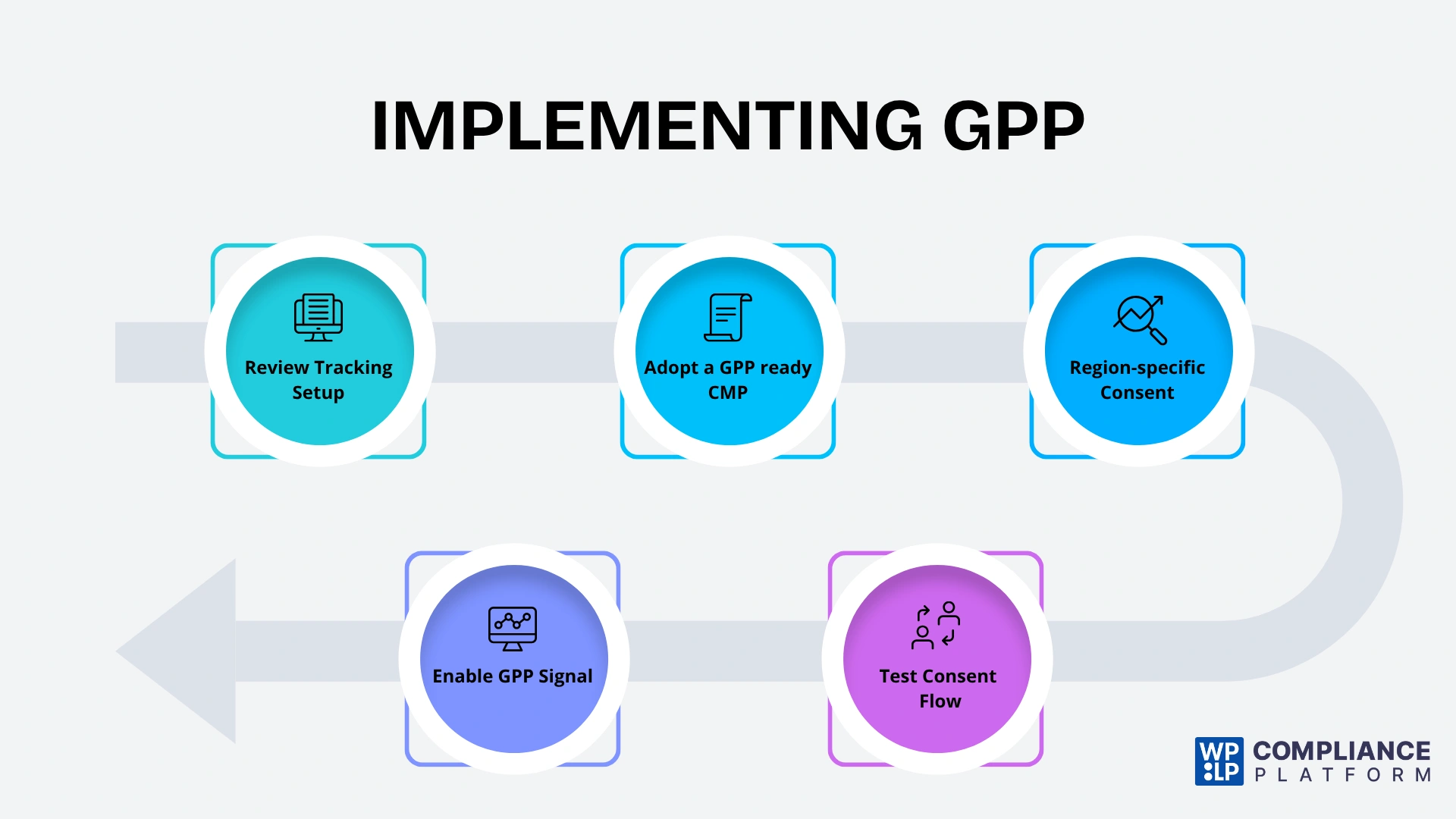
Here are some steps for implementing GPP successfully:
1. Review Your Current Tracking Setup
Determine which cookies, analytics tools, and advertising scripts your site is using. Identify which and in their functionality require consent.
2. Use a CMP That Supports the GPP
Your Consent Management Platform (CMP) should have the capability to capture consent from users and automatically send GPP signals.
3. Adjust Consent Options
Different areas of the globe have different requirements (eg, the EU requires explicit opt-in, California requires Do Not Sell/Sharing). Ensure consent categories reflect those requirements.
4. Enable GPP Signal Sharing
Share GPP signals so ad networks like Google, Meta, DSPs, and other platforms will see the consent choices automatically.
5. Test the Consent Flow
Approve and deny consent options while reviewing the list of visible and blocked scripts to ensure the appropriate scripts are loading or unobstructed as required.
How Do Cookie Consent and GPP Relate
GPP helps to differentiate between what users see and what occurs behind the scenes. The cookie consent banner is the front-end aspect of privacy compliance.
Users directly engage with these cookie banners and make an active choice to either opt-in or opt-out. Once that choice has been made, GPP acts as the back-end communication layer.
GPP takes the user’s consent selections and converts them into a standardized signal that is recognized by any platform, such as Google Ads, Meta (Facebook), Demand Side Platforms (DSPs), Analytics, ad networks, and data vendors.
Before GPP, each platform interpreted consent individually, leading to miscommunication between the banners and the tools, inconsistent tracking, and a higher risk for compliance.
With GPP, the consent message has the same and consistent meaning, every tool connected to it interprets the user’s selection the same way.
Cookie banners are what collect the user’s choices. GPP comes into play once the user has made a choice. It simply sends those consent signals to any and all affiliates without any type of hiccup. Both are needed and neither replaces the other.
Best Practices for Smooth GPP Compliance
Preparing for GPP compliance should not feel like an overwhelming task. If you implement a solid consent procedure and are clear in your communication, you can comply with GPP requirements and keep user trust.
Make your cookie banners transparent and correctly categorized: Make sure the banner clearly distinguishes between essential and non-essential cookies so users can make informed decisions without any ambiguity.
Confirm your Privacy Policy mentions whether you process global privacy signals: Your policy should alert users whether, and how, your site processes GPP signals (e.g., opting out of certain data collection and tracking).
Log all consent events: Be sure to have secure tracking of when your users consented, how they consented, and what they consented to; you may need consent logs in the event of an audit or legal inquiry.
Use region-based banners: Show different consent notices for visitors based on their location. This ensures compliance with regional privacy laws with no excess manual workload.
Frequently Asked Questions (FAQ)
No, GDPR is the governing law. GPP is the privacy framework that allows you to comply with many laws consistently.
Not globally, but many online platforms are adopting it as the preferred standard.
Yes, your CMP must be able to receive and capture the consent that GPP communicates with.
No, cookie banners are designed to collect consent. GPP transmits that consent to various platforms and tools.
No, GPP is invisible to the user. It only impacts how the consent data is communicated to the platforms.
Consent preferences might not be appropriately shared with the advertising or analytics tools, which could create risks for data non-compliance and tracking inaccuracies.
No, GPP also impacts analytics, embedded content, personalization tools, and any script that could process personal data.
Conclusion
The Global Privacy Platform (GPP) signifies the future of privacy compliance, streamlining how consent is obtained, communicated, and verified anywhere in the world.
Applying GPP is a reliable way to ensure that users’ privacy preferences are respected uniformly across regions and technology platforms.
GPP improves compliance, reduces the need for manual configuration, and increases transparency around consent sharing in the advertising and analytics ecosystem.
By using GPP now, you position your privacy processes to be future-ready as global privacy expectations continue to evolve over time.
If you enjoyed this article, consider reading these blog posts: