Summary
An Impressum is a legally required disclosure for many commercial websites that target users in Germany, Austria, and Switzerland.
It identifies the website owner, provides contact and business information, and helps meet legal disclosure requirements. Knowing when an Impressum is required, what it should include, and where to display it can help your business stay compliant and build trust with visitors.
Ever come across the term Impressum and wondered whether your website needs one?
If your business operates in Germany, Austria, Switzerland, or targets users in these countries, an Impressum may be a legal requirement. It serves as an official disclosure that identifies who owns and operates your website, making it easier for visitors and authorities to contact the responsible party.
In this guide, you’ll learn what an Impressum is, who needs one, and what goes in it. You’ll also get 3 Impressum examples you can copy and edit.
What is an Impressum?
An Impressum is a legally required disclosure that identifies the owner or operator of a website, publication, or other digital service. “Impressum” is German for “imprint”. In English, it’s often called a “legal notice” or “site notice”.
The word comes from the Latin impressum, “pressed in” or “imprinted”. Printers once had to print their name and address in every book and newspaper. A website Impressum does the same job online: it tells readers who is behind the content.
In German law, you’ll also see the terms “Impressumspflicht” (the duty to have an Impressum) and “Anbieterkennzeichnung” (provider identification).
In German-speaking countries, an Impressum provides essential business information so visitors know who is responsible for the content published on a website.
Depending on the business, an Impressum may include:
- Business or individual name
- Registered business address
- Email address
- Phone number
- Company registration details
- VAT identification number
- Authorized representative
- Regulatory authority details (where applicable)
Unlike a Privacy Policy, an Impressum is primarily about legal ownership and accountability, not data privacy.
Impressum vs Privacy Policy
Many sites need both. They answer different questions: the Impressum says who runs the site, and the Privacy Policy says what happens to visitors’ data.
| Impressum | Privacy Policy |
|---|---|
| Identifies the owner or operator of the website. | Explains how personal data is collected, used, stored, shared, and protected. |
| Includes business details such as company name, address, contact information, registration details, and VAT number where applicable. | Describes data collection practices, cookies, analytics, third-party services, user rights, and data retention. |
| Primarily intended to meet legal disclosure requirements. | Primarily intended to inform users about their privacy rights and data processing activities. |
| Required mainly under the disclosure laws of Germany, Austria, and Switzerland. | Required under privacy laws such as the GDPR, CCPA, LGPD, PIPEDA, and others, depending on where your users are located. |
| Failure to comply may lead to warnings, fines, or legal action. | Failure to comply may result in regulatory penalties, investigations, or legal action under applicable privacy laws. |
Who needs an Impressum?
An Impressum is generally mandatory for commercial websites operating in or targeting users in Germany, Austria, and Switzerland.
Each country has its own law:
| Country | Main legal basis | Who it covers |
|---|---|---|
| Germany | § 5 Digitale-Dienste-Gesetz (DDG), in force since 14 May 2024. It replaced § 5 of the Telemediengesetz (TMG). | Business-like digital services, usually offered for payment. Sites with journalistic or editorial content also need a “responsible person” under § 18 (2) Medienstaatsvertrag (MStV). |
| Austria | § 5 E-Commerce-Gesetz (ECG). Company details under § 14 UGB (registered companies) or § 63 GewO (other traders). Media disclosure (“Offenlegung”) under § 25 Mediengesetz (MedienG). | All commercial websites. The MedienG duty depends on the site’s content. |
| Switzerland | Art. 3 (1) (s) (1) of the Federal Act against Unfair Competition (UWG). | Anyone who offers goods, works, or services online. They must give clear and complete details of their identity and contact address, including email. |
Commercial websites are not the only ones affected. The requirement may also apply to:
- Online stores
- Company websites
- Professional blogs
- News publications
- Online magazines
- Business landing pages
- Certain commercial social media pages
Personal websites that are purely private and not operated for commercial purposes are generally exempt. A blog with ads, affiliate links, or sponsored posts usually counts as commercial.
Do businesses outside Germany, Austria, or Switzerland need one?
Often, yes. This is one of the most common questions website owners ask. You don’t need to be physically located in Germany for the Impressum requirement to apply.
Your business may still need one if you:
- Target customers in Germany, Austria, or Switzerland.
- Offer products or services in German.
- Operate a German-language version of your website.
- Specifically market to consumers in these countries.
If your website primarily serves audiences outside German-speaking countries, an Impressum may not be legally required. If you sell to German customers, check whether the DDG applies to you.
When in doubt, consulting a legal professional familiar with German digital regulations is recommended.
What must an Impressum include?
§ 5 DDG lists the core details German commercial websites must disclose. Two other laws add items for some businesses. Which items apply depends on your type of business.
Include these details, where they apply to you:
- Full business or individual name
- Registered business address (a street address that can receive post; a P.O. box is not enough)
- Email address
- Telephone number or another fast, direct way to contact you
- Legal form, and the names of the people authorized to represent the company (for example, the managing director of a GmbH)
- Commercial register, register court, and registration number
- VAT identification number or business identification number
- Supervisory authority details, if your business needs a permit
- Professional title, the country that granted it, and your professional chamber, for regulated professions (doctors, lawyers, architects, and others)
- A “responsible person” (name and address) under § 18 (2) MStV, if you publish journalistic or editorial content
- A statement on consumer dispute resolution under § 36 VSBG, if your business had more than 10 employees on 31 December of the previous year. Say whether you take part in dispute resolution before a consumer arbitration body (Verbraucherschlichtungsstelle). If you won’t take part, you still have to say so. You can put this statement in the Impressum or in your terms.
If your Impressum still links to the EU online dispute resolution (ODR) platform, remove the link. The EU deleted the platform on 20 July 2025.
Your Impressum does not need a copyright notice or data protection details. Those belong in your terms and your Privacy Policy.
Impressum example (copy and edit)
German Impressums are usually written in German. Below are 3 samples with fake data. Replace every detail with your own and delete the lines that don’t apply.
These samples are a starting point, not legal advice. Have a lawyer check your final text.
Example 1: German GmbH
Impressum

Angaben gemäß § 5 DDG

Muster GmbH
Musterstraße 1
10115 Berlin
Deutschland

Vertreten durch die Geschäftsführerin:
Erika Mustermann

Kontakt:
Telefon: +49 30 1234567
E-Mail: [email protected]

Registereintrag:
Eintragung im Handelsregister
Registergericht: Amtsgericht Berlin-Charlottenburg
Registernummer: HRB 123456

Umsatzsteuer-ID:
Umsatzsteuer-Identifikationsnummer gemäß § 27a Umsatzsteuergesetz:
DE123456789
Example 2: Sole trader (Einzelunternehmer)
A sole trader must use their full first and last name. A business name can go next to it, never in place of it.
Impressum

Angaben gemäß § 5 DDG

Max Mustermann
Mustermann Webdesign
Beispielweg 5
80331 München
Deutschland

Kontakt:
Telefon: +49 89 7654321
E-Mail: [email protected]

Umsatzsteuer-ID:
Umsatzsteuer-Identifikationsnummer gemäß § 27a Umsatzsteuergesetz:
DE987654321
Example 3: Blog with editorial content
Use this if your blog is commercial (ads, affiliate links, sponsored posts) and publishes articles or news.
Impressum

Angaben gemäß § 5 DDG

Anna Beispiel
Blogstraße 10
50667 Köln
Deutschland

Kontakt:
Telefon: +49 221 112233
E-Mail: [email protected]

Verantwortlich für den Inhalt nach § 18 Abs. 2 MStV:
Anna Beispiel
Blogstraße 10
50667 Köln
What happens if you don’t have an Impressum?
Failing to publish a legally required Impressum can have serious consequences, particularly for businesses operating in Germany.
One of the most common enforcement mechanisms is an Abmahnung, a formal legal warning issued by competitors, consumer protection organizations, or business associations, requesting that the violation be corrected.
Depending on the situation, businesses may face:
- Legal warning notices (Abmahnung)
- Attorney fees
- Fines
- Court proceedings
- A cease-and-desist declaration with a contractual penalty for repeat violations
In Germany, a missing, wrong, or incomplete Impressum can lead to a fine of up to €50,000 under § 33 DDG (IHK Rhein-Neckar).
Beyond legal consequences, not having an Impressum can also reduce customer confidence. Visitors may hesitate to engage with a business if ownership and contact information aren’t clearly disclosed.
What to do if you get an Abmahnung
An Abmahnung usually comes with a short deadline and a cease-and-desist declaration (“Unterlassungserklärung”) to sign. Don’t ignore it. If the deadline passes, the sender can go to court.
- Note the deadline.
- Fix the Impressum right away, so the violation stops.
- Don’t sign the declaration as sent. It can commit you to a contractual penalty for any future slip.
- Talk to a lawyer who handles competition law. They can check whether the claim and the fees are valid, and change the declaration if needed.
This is general information, not legal advice.
Common Impressum mistakes
Check your Impressum for these gaps:
- A P.O. box in place of a street address. You need an address where you can receive legal documents.
- No legal form. “Muster” is not enough. Write “Muster GmbH”.
- No representative. A GmbH must name its managing director(s).
- Email only, with no second contact option. Add a phone number or a contact form.
- Old details. A previous address, a former managing director, or an old VAT ID.
- Link on the homepage only. The link has to be on every page, including shop and blog pages.
- Copied text from another site. Their register court, VAT ID, or legal form won’t match yours.
- Privacy text mixed into the Impressum. Keep the Privacy Policy on its own page and link to it.
How to create an Impressum on WordPress
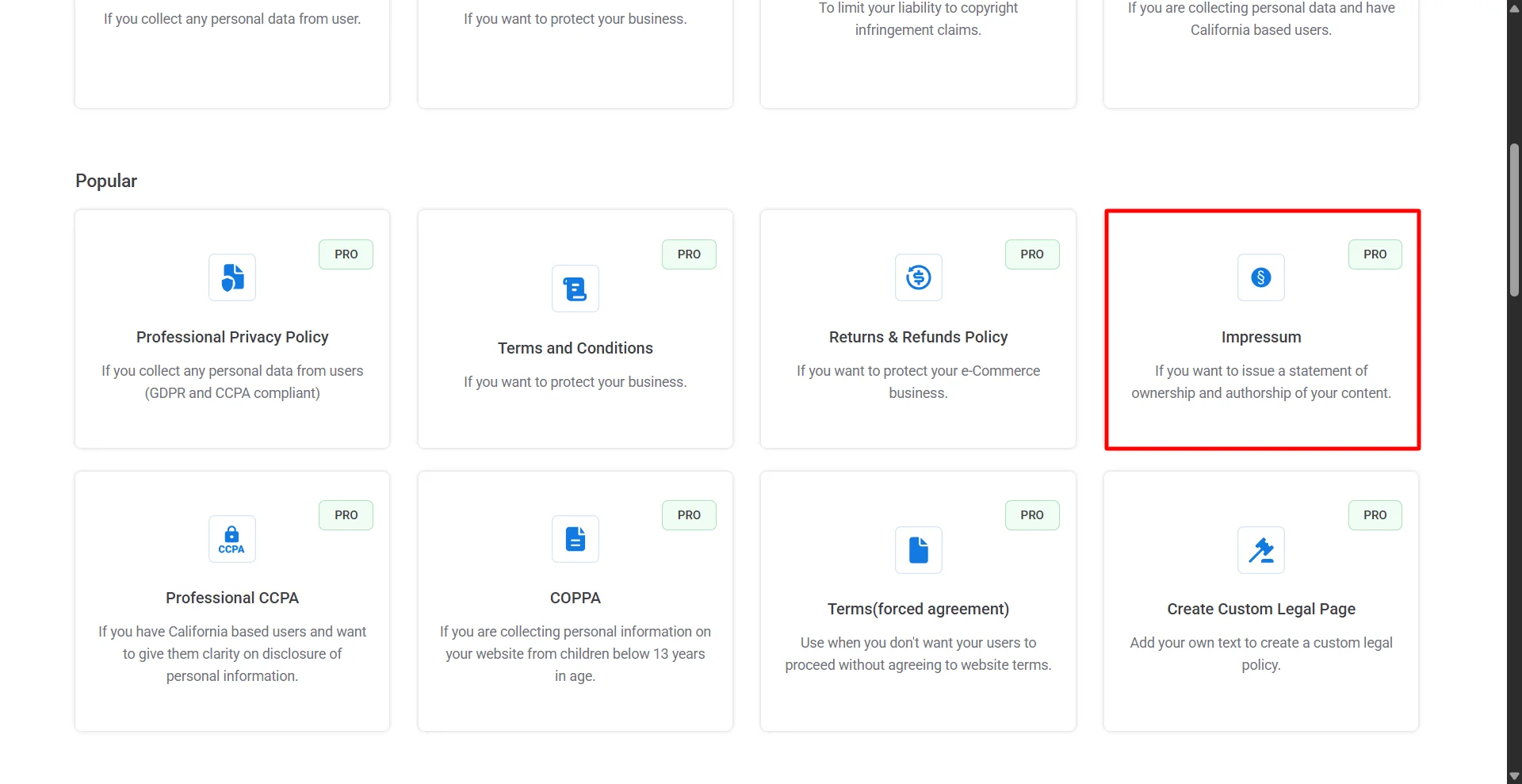
The Impressum generator in WPLP Legal Pages builds the page inside your WordPress dashboard. You enter your business details once, preview the Impressum, and publish it on your own domain.
Simply select the Impressum template and enter your business details.
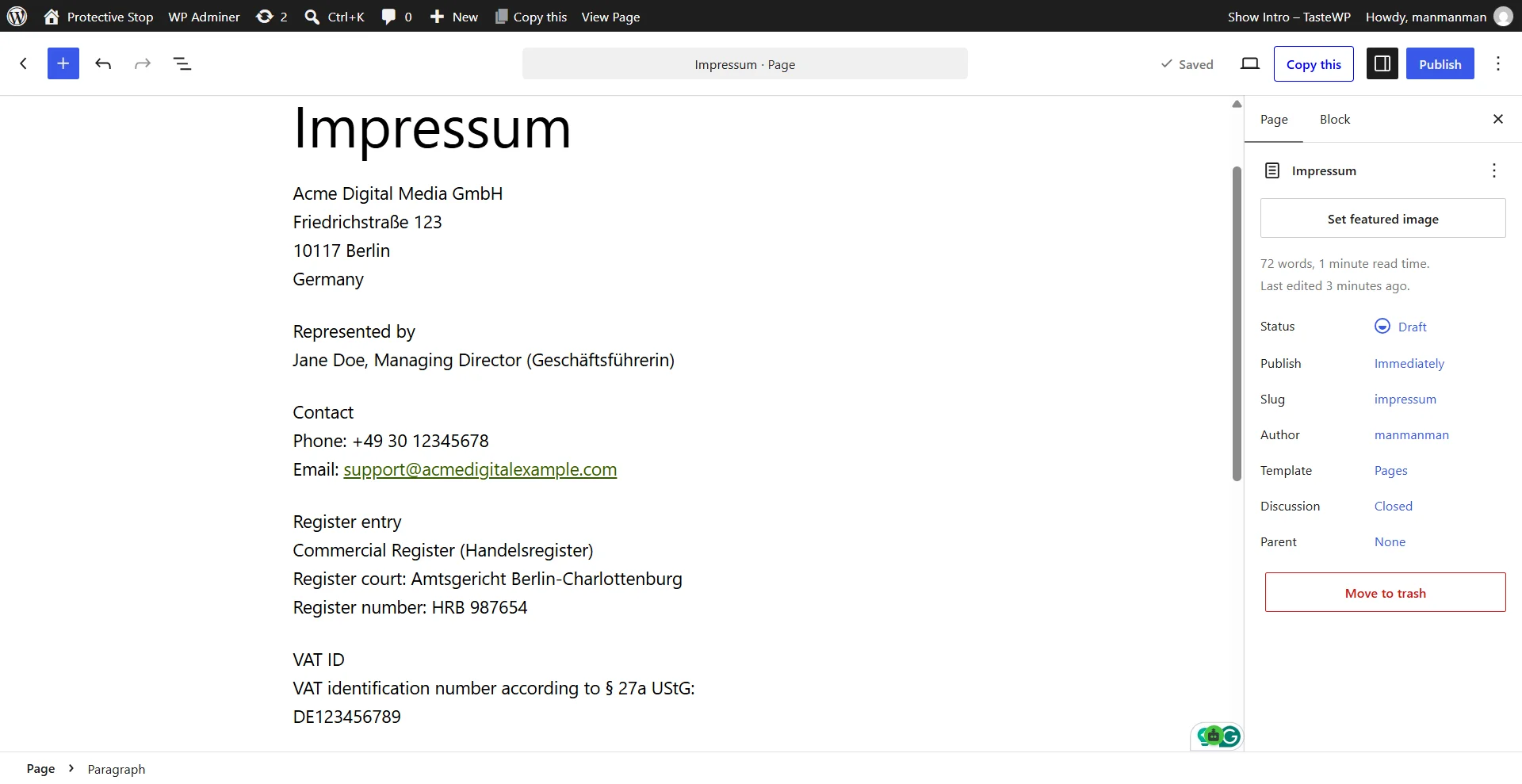
Preview the generated page, make any necessary edits, and click Publish to make it available on your website.
Frequently Asked Questions About Impressum
List who runs the site and how to reach them: full name or company name, street address, email, and phone. Then add what applies to your business, such as legal form, representatives, register number, and VAT ID. Use the examples above as a starting point.
No. An Impressum and a Privacy Policy serve different purposes. An Impressum identifies the business or individual responsible for the website, while a Privacy Policy explains how personal information is collected, used, stored, and shared. Many commercial websites need both documents.
A purely private blog with no commercial purpose is generally exempt. Once you run ads, affiliate links, or sponsored posts, it usually counts as commercial and needs one.
If your website is legally required to have an Impressum and you fail to publish one, you may receive a legal warning (Abmahnung), incur legal costs, or face a fine of up to €50,000 in Germany. Publishing an accurate and accessible Impressum helps reduce these compliance risks.
Yes, if the link on your Facebook page is easy to find and goes straight to your Impressum. See our guide to writing a Facebook Impressum for the setup.
Conclusion
An Impressum tells visitors and authorities who runs your website. If you sell to people in Germany, Austria, or Switzerland, you probably need one.
Start with one of the examples above, or build yours with the Impressum generator. Link it from your footer, and update it when your business details change.
If you’ve liked reading this article, don’t forget to check our other engaging content:
- Top Cookie Consent Plugins for WordPress
- Simplified Guide to Set Up Cookie Banners for eCommerce
- How to Write a Facebook Impressum
Need an Impressum on your WordPress site? Create one with the Impressum generator in WPLP Legal Pages.