You wrote the posts. You took the photos. Someone can still copy them in 2 clicks.
A copyright notice tells every visitor, in one line, that your content has an owner and who that owner is. In the US, it also removes one defense a copier can use in court.
Here’s the tl;dr:
- A copyright notice is the short line in your footer that says who owns your content. Example: © 2026 Jane Doe.
- In WordPress, you add it in your theme’s footer settings or in the Site Editor. It takes about 5 minutes.
- Keep the year current. Then add a DMCA policy so people know how to report copied content.
What is a copyright notice?
Copyright protects original work: blog posts, photos, videos, illustrations, code.
In the US and most other countries, protection starts automatically. It starts when you create the work and fix it in a tangible form, such as saving the file or publishing the post. You don’t have to register anything or add a notice to own the copyright.
Copyright gives the owner the exclusive right to:
- copy the work
- distribute it
- make new works based on it (adaptations, translations)
- display or perform it in public
Anyone else needs your permission (a license) to do these things, unless an exception such as fair use applies.
A copyright notice is the public statement of that ownership. It usually sits in the website footer:
© 2026 Acme Studio LLC. All rights reserved.
How long does copyright last?
It depends on the country. In the US (17 U.S.C. § 302), for works created on or after January 1, 1978:
- Individual author: the author’s life plus 70 years.
- Works made for hire, anonymous, or pseudonymous works: 95 years from first publication or 120 years from creation, whichever ends first.
Countries that signed the Berne Convention must give at least the author’s life plus 50 years. Many give more.
Do you need to register your copyright?
You don’t need to register to own the copyright. In the US, registration matters when you want to enforce it:
- You must register a US work (or have registration refused) before you can file an infringement lawsuit. (17 U.S.C. § 411)
- Statutory damages and attorney’s fees are only available if you registered before the infringement started, or within 3 months of publication. (17 U.S.C. § 412).
You register with the US Copyright Office.
What goes in a copyright notice
A US copyright notice has 3 elements:
- The symbol ©, the word “Copyright”, or the abbreviation “Copr.” Many sites use both: “Copyright ©”.
- The year of first publication. Only the year. No month or day.
- The name of the copyright owner. A person, a company, or an organization. A short form of the name is fine if people can recognize it.
Put the 3 elements together on one line: © 2026 Jane Doe.
The rights statement (optional)
Many sites add a short statement after the notice. It tells people what they can do with your content. There are 3 common types:
- All rights reserved. You keep every right. Nobody can reuse the content without your permission.
- Some rights reserved. People can reuse the content if they follow your conditions. Creative Commons licenses work this way. Example: CC BY 4.0 allows reuse with credit to you.
- No rights reserved. You give up your rights and put the work in the public domain. The Creative Commons CC0 tool does this.
A rights statement is optional. Add one when you want readers to see your reuse terms at a glance.
Copyright notice examples for websites
Copy one and replace the year and name:
© 2026 Jane Doe. All rights reserved.Copyright © 2018–2026 Acme Studio LLC. All rights reserved.© 2026 Jane Doe. Text licensed under CC BY 4.0. Photos: all rights reserved.
The year range in the second example suits a site that has published new content every year since 2018.
Why add a copyright notice if it’s optional?
In the US, a notice is optional for works published on or after March 1, 1989. Most countries in the Berne Convention also don’t require one. It still helps you in 3 ways:
- It names the owner. People who want to license your photo or quote your post know who to ask.
- It removes the “I didn’t know” defense. Under US law (17 U.S.C. § 401(d)), if a proper notice appears on the work a copier saw, the court gives no weight to an “innocent infringement” defense when it decides damages. Without a notice, a copier can claim they didn’t know the work was protected and ask for lower damages.
- It shows the site is active. A current year tells visitors someone looks after the site.
Copyright vs trademark vs patent
People mix these up. Each protects a different thing:
| Copyright | Trademark | Patent | |
|---|---|---|---|
| Protects | Original creative work: text, images, video, music, code | Names, logos, and slogans that identify a brand | Inventions, processes, and product designs |
| How you get it | Automatic when you create the work | By using the mark in business. Registration adds rights | Only after the patent office examines and grants it |
| How long (US) | Life + 70 years (most works) | As long as you keep using it. Registrations renew every 10 years | Utility patents: generally 20 years from filing |
| Who registers it (US) | US Copyright Office | USPTO | USPTO |
Copyright does not protect ideas, facts, names, or short phrases. On your website, the text of a blog post is copyright. The name and logo of your blog are trademarks.
Copyright outside the US
The basics are the same in every Berne Convention country: protection is automatic, and a notice is optional. The details differ:
| Country | How long it lasts (most works) | Registration | Official source |
|---|---|---|---|
| UK | Author’s life + 70 years | No register. Protection is automatic | GOV.UK: https://www.gov.uk/copyright |
| Canada | Author’s life + 70 years (since 30 December 2022, up from 50) | Optional, with the Canadian Intellectual Property Office (CIPO) | CIPO: https://ised-isde.canada.ca/site/canadian-intellectual-property-office/en/copyright |
| India | Author’s life + 60 years | Optional, with the Copyright Office under the Copyright Act, 1957 | Copyright Office India: https://copyright.gov.in/ |
The same © line works in all 3 countries. What changes is how you enforce your rights, so check the local rules if you need to take action.
How to add copyright text in WordPress
The footer is the standard place for copyright text. Visitors expect it there, and it shows on every page.
How you edit the footer depends on your theme.
Option 1: Classic theme (example: Responsive)
The Responsive theme has a copyright field in its footer settings:
- In your WordPress dashboard, go to Appearance > Customize.
- Click Footer.

- Click Layout.
- Find the Copyright HTML box and type your copyright text.
- Click Publish.
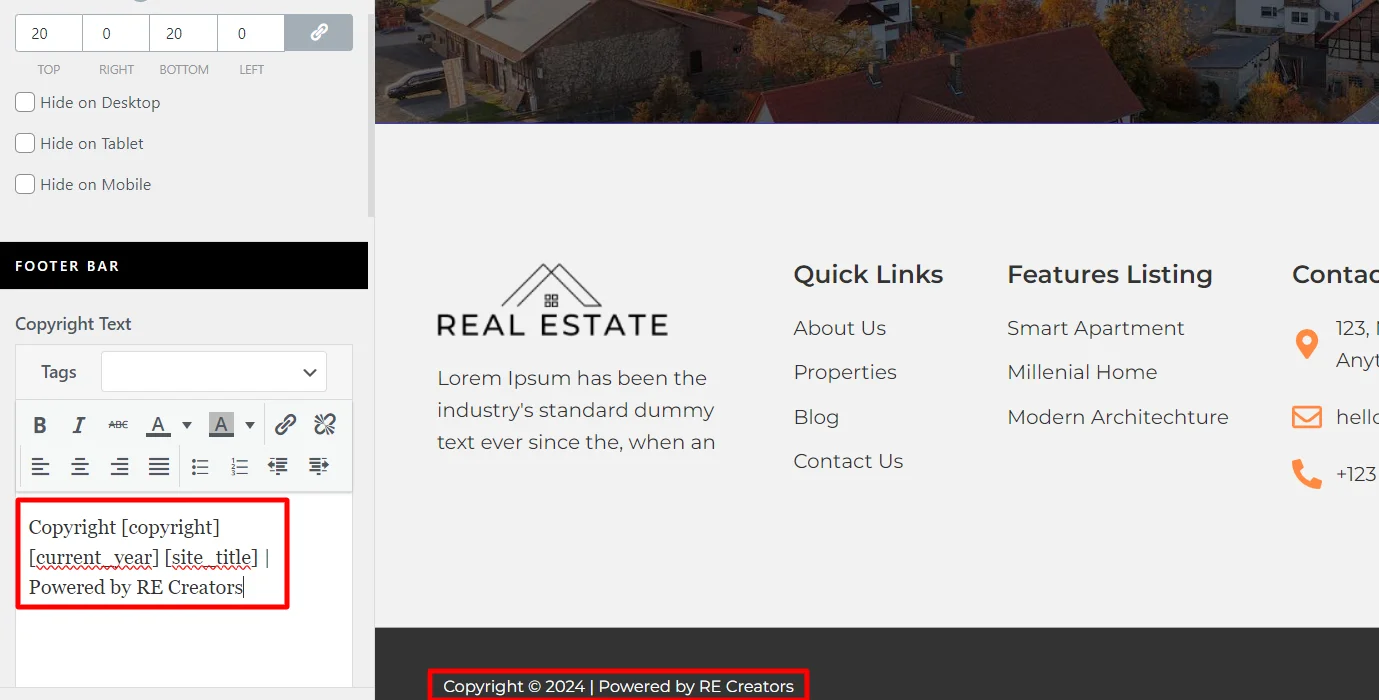
Most classic themes have a similar field under Appearance > Customize > Footer or in the theme’s own options panel. The labels change from theme to theme.
Option 2: Block theme (Site Editor)
Block themes such as Twenty Twenty-Five edit the footer in the Site Editor:
- Go to Appearance > Editor.
- Open Patterns > Template parts > Footer.
- Click the text block in the footer and type your copyright text.
- Click Save.
Keep the year current automatically
If you edit theme files, PHP can print the current year for you. Add this to the footer.php file of a child theme. If you edit the parent theme, the next theme update deletes your change.
php
© 2018–<?php echo esc_html( wp_date( 'Y' ) ); ?> Acme Studio LLC. All rights reserved.
In 2026, this prints: © 2018–2026 Acme Studio LLC. All rights reserved.
wp_date() uses the time zone set in Settings > General, so the year changes at midnight in your time zone, not the server's. It needs WordPress 5.3 or later.Some themes and page builders have a dynamic year tag in the footer settings. Check your theme’s documentation first. It saves you from editing code.
Add a DMCA policy with WPLP Legal Pages
The copyright notice says you own your content. A DMCA policy is a separate page. It tells people how to report content on your site that they think infringes their copyright, and who to send the report to.
You need one if visitors can post content on your site, such as comments, reviews, or uploads. To get the DMCA “safe harbor” in the US, you must also register a designated agent with the US Copyright Office. Read our guide to the Digital Millennium Copyright Act for the full process.
The DMCA notice template is free in WPLP Legal Pages, our WordPress plugin. You can also write the page yourself. It needs your agent’s name and contact details, and how to send a takedown notice.
- Go to Plugins > Add New Plugin. Search for WPLP Legal Pages, then click Install Now and Activate.
- Open Legal Pages > Create Page.
- Fill in your business profile: business name, domain, and address. Every legal page you create uses these details.
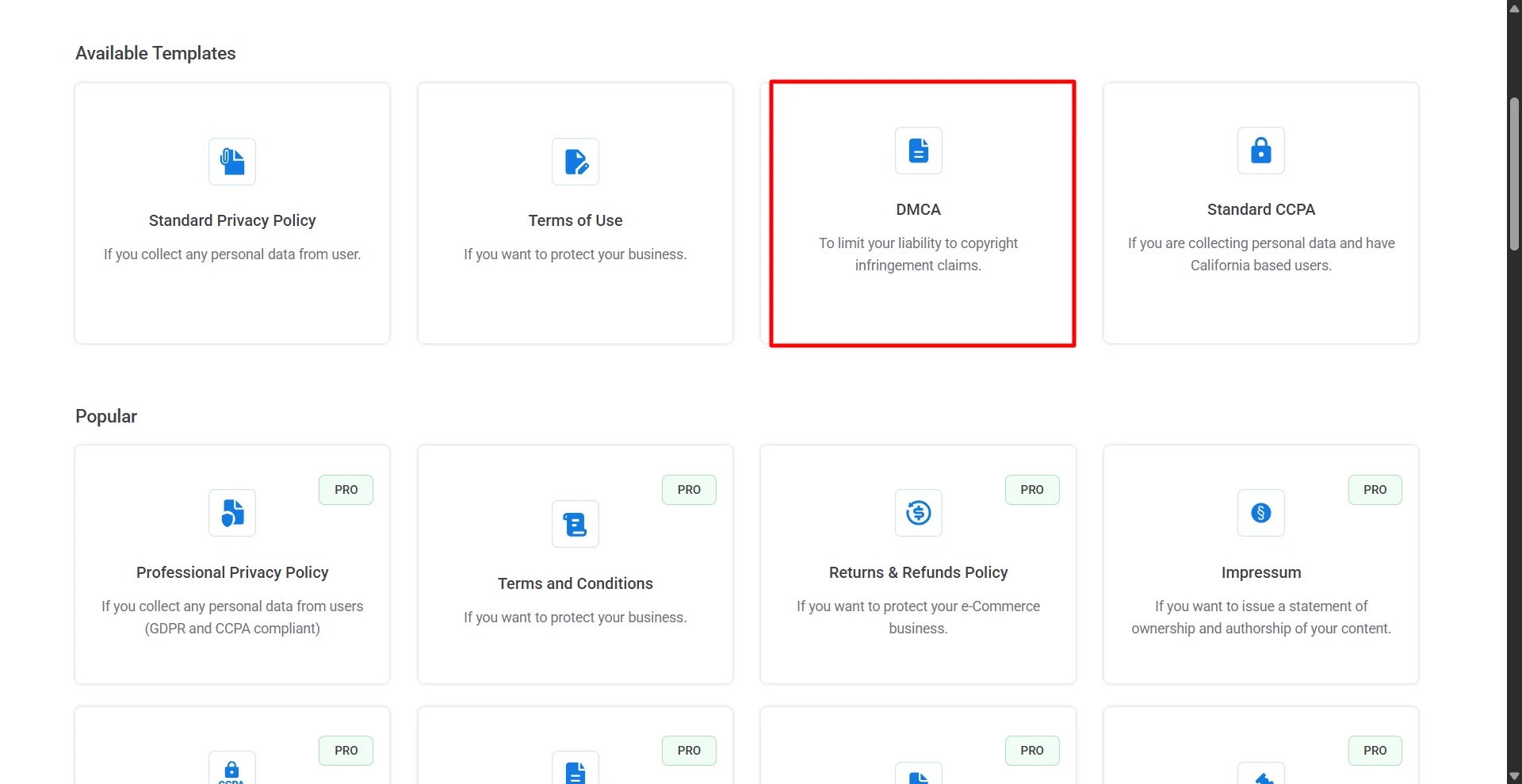
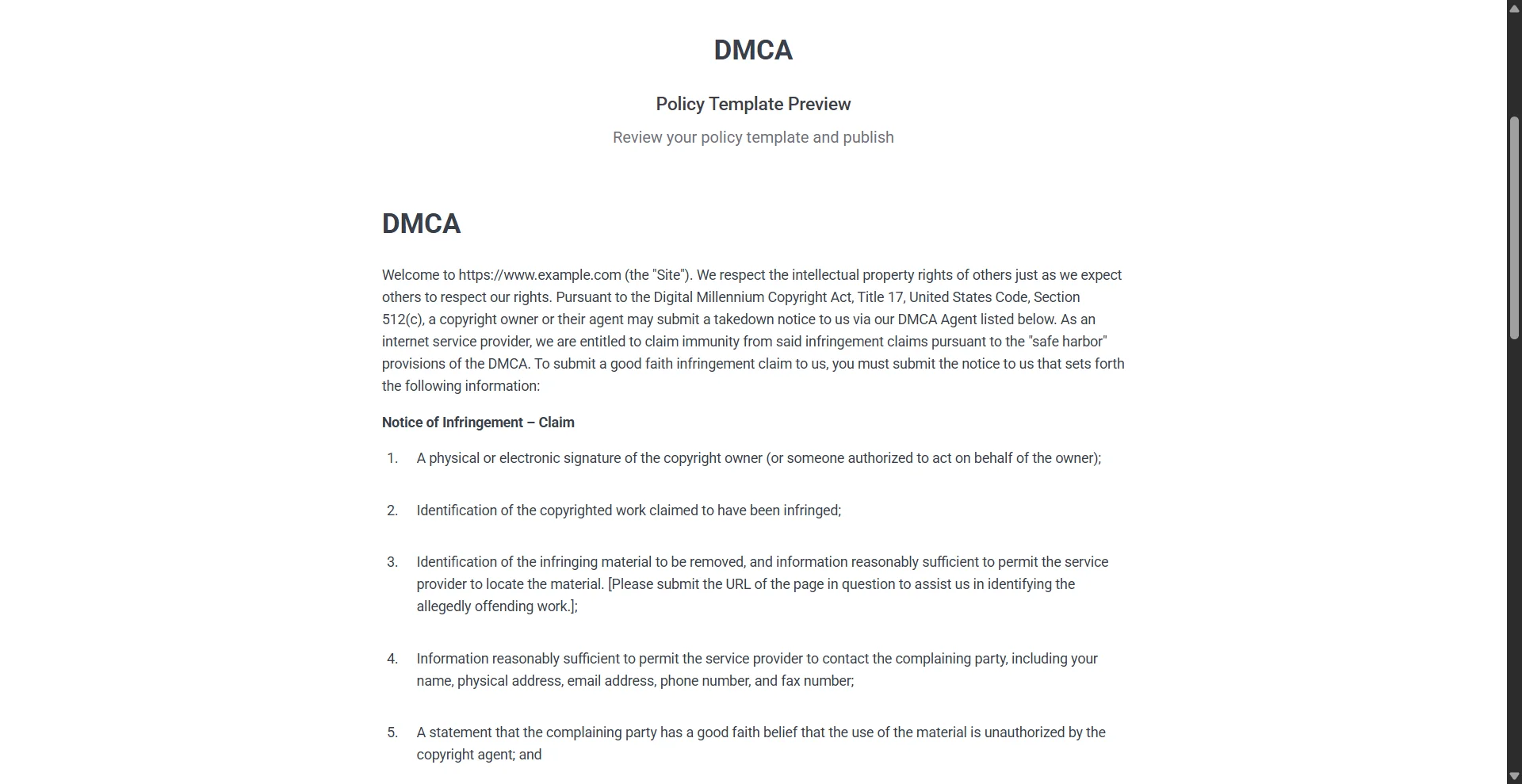
- Choose the DMCA template and answer the questions.
- Click Publish.
- Link the DMCA page in your footer, next to your copyright notice.
Other legal pages your site needs
A copyright notice and a DMCA policy cover your content. Most sites also need a privacy policy and terms of use. Both are free in WPLP Legal Pages, and 30+ more templates are on paid plans. See the legal pages every website needs.
How to keep your copyright protection current
Update the year. Do it every January, or use the automatic snippet above. An old year does not cancel your copyright. It does make the site look unmaintained.
Review your legal pages. When you add comments, a shop, or user uploads, check that your DMCA policy, privacy policy, and terms still match what the site does.
Watch for copies. Set a Google Alert for a distinctive sentence from your best posts. For images, use a reverse image search such as Google Images or TinEye.
Act on copies you find. First, contact the site owner and ask them to remove or credit the content. If that fails, send a DMCA takedown notice to the site’s host. Our guide on protecting your content from plagiarism covers each step.
Choose a license. If you want people to reuse your work on your terms, a Creative Commons license lets you set the conditions and keep ownership.
Using other people’s content: permission and fair use
The rules work in both directions. Before you use someone else’s text, image, or video on your site:
Ask the owner. If you know who owns the work, contact them and ask for permission. Get the permission in writing.
Find the owner. If you don’t know who owns it, search the US Copyright Office’s Copyright Public Records System. It only lists registered works. A work that is not in the records can still be protected. The Copyright Office can also do a search for you, for a fee.
Check fair use. (US law (17 U.S.C. § 107) allows limited use of protected work without permission for purposes such as criticism, comment, news reporting, teaching, and research. Courts weigh 4 factors:
- The purpose of your use (for example, commentary or a commercial use).
- The type of work you used.
- How much of the work you used.
- The effect of your use on the market for the original.
There is no safe word count or percentage. A credit line alone does not make a use fair. Outside the US, countries such as the UK, Canada, and India use “fair dealing”, which allows fewer uses.
Free legal templates have the same rule. You can’t copy another site’s privacy policy or terms and conditions word for word.
Frequently asked questions
Is a copyright notice required?
No. In the US, a notice is optional for works published on or after March 1, 1989. Most countries don’t require one either, because the Berne Convention bans formalities as a condition of protection. A notice is still worth adding because it names the owner and, in the US, removes the innocent infringement defense.
Should I update the copyright year every year?
The year in the notice is the year of first publication. A website gets new content over time, so many sites use a range, such as © 2018–2026. The first year shows when the oldest content was published. The second shows the newest.
Updating the year does not make your copyright last longer. An old year does not cancel your copyright either. It only makes the site look neglected.
What does “All rights reserved” mean?
It means the owner keeps all rights in the work, and nobody can reuse it without permission. The phrase comes from the 1910 Buenos Aires Convention, which required it in some countries. Today it adds no extra legal protection in Berne Convention countries. It is harmless, and many sites keep it to make their position clear.
Where should I put the copyright notice on my website?
In the footer, so it shows on every page. For photos and graphics that people may download, you can also add a watermark or a caption with the © line.
Related reading
- What Is DMCA? Digital Millennium Copyright Act Guide
- How to Protect Your Content From Plagiarism
- Can You Copy a Privacy Policy?
- Can I Copy Terms and Conditions?
This guide explains US copyright law first, with notes for the UK, Canada, and India. It’s general information, not legal advice.