The Digital Services Act (DSA) is a European Union law that regulates online platforms to make the internet safer, more transparent, and more accountable.
It applies to platforms like marketplaces, social media, and hosting services, requiring them to remove illegal content, protect users, and disclose how their systems work.
If your business operates in the EU or targets EU users, understanding the DSA is not optional. This guide explains everything you need to know.
What is the Digital Services Act (DSA) of the EU?
First, let’s start with the fundamentals so that we can understand what the Digital Services Act, or DSA, is.
The Digital Services Act is a powerful piece of legislation passed in the European Union that ensures users’ data privacy. It aims to transform the digital space to provide a safer and more transparent environment within the European Union.
It places responsibilities on digital services, especially online platforms, to act in the best interests of their users, concerning their fundamental rights and equality.
Specifically, the DSA requires companies to take preventive measures related to content moderation, transparency reporting, and the protection of user rights.
Important distinction: The DSA is not a data privacy law; that is the role of the GDPR. The DSA is specifically about platform responsibility and content moderation. It regulates what platforms must do about illegal content, algorithmic transparency, and user protection, not how they handle personal data.
DSA explained in simple terms
If you strip away the legal language, the DSA essentially does five things:
- What is its purpose? The DSA establishes rules for all online platforms operating within Europe, i.e., from a very small hosting provider to a multi-billion-dollar social network.
- Removal of Illegal Online Content: Every online platform must have measures in place to identify, report and facilitate rapid removal of illegal content and provide documentation of the measures taken.
- Transparency: Online platforms are required to provide transparent information about their recommendation systems and ad targeting. No longer can they use an algorithm for which the public has no knowledge of how it works.
- User Rights: Users will have the right to appeal the removal of any content from any online platform, and all terms of service will be written in a more accessible and fair manner.
- Liability For Big Tech: VLOPs, or very large online platforms, will be subject to stricter requirements than their smaller counterparts, including independent audits and a system of checks to evaluate the risk posed by the operation of their platforms.
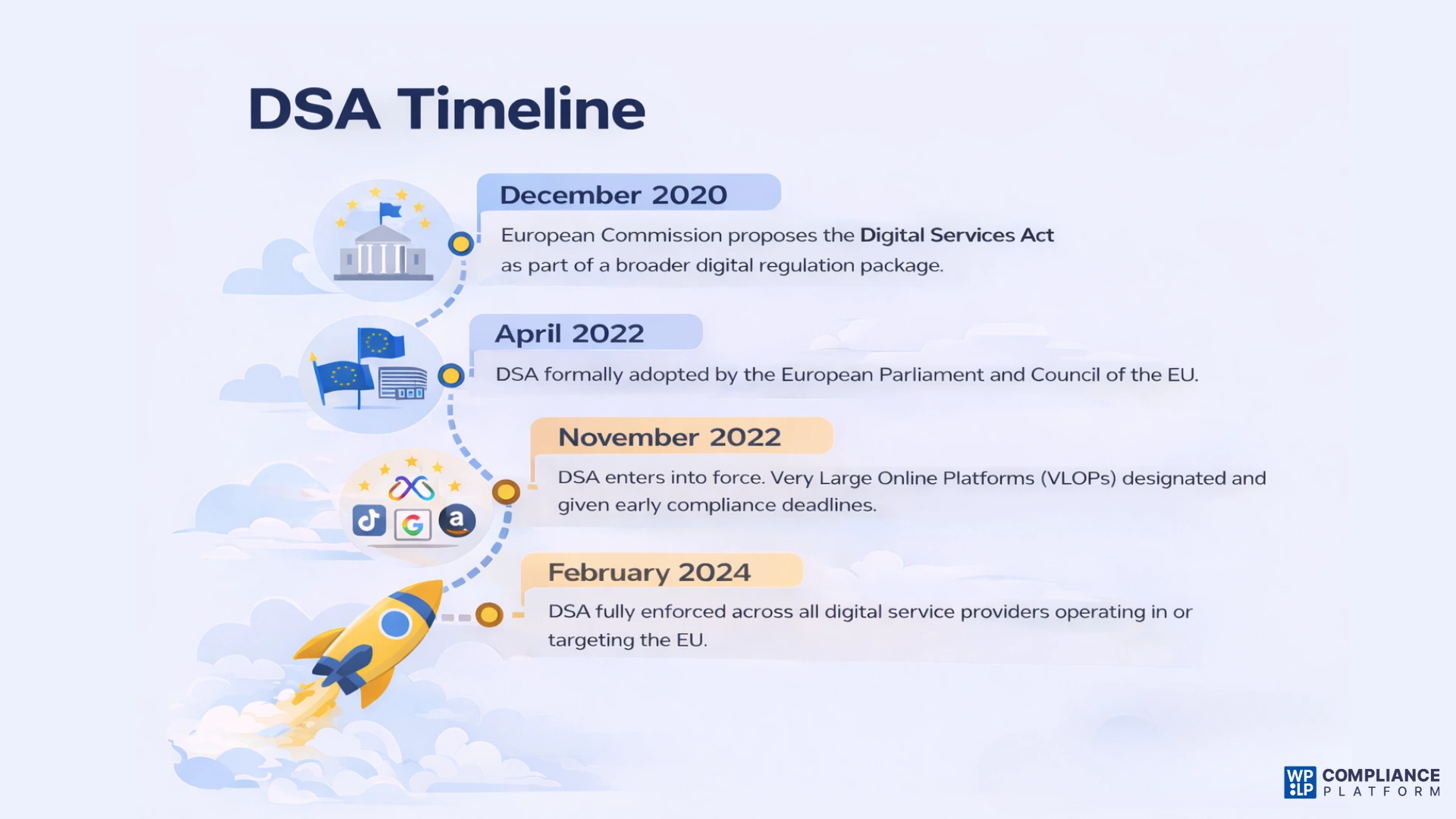
Key Provisions of the Digital Services Act (DSA)
While the above was just a brief description of DSA, let’s now get into its details to understand each of its components.
Each of these provisions aims to promote a higher level of safety and transparency in the digital space, protect users’ rights, and foster the responsible use of platforms.
The key provisions of DSA are as follows:
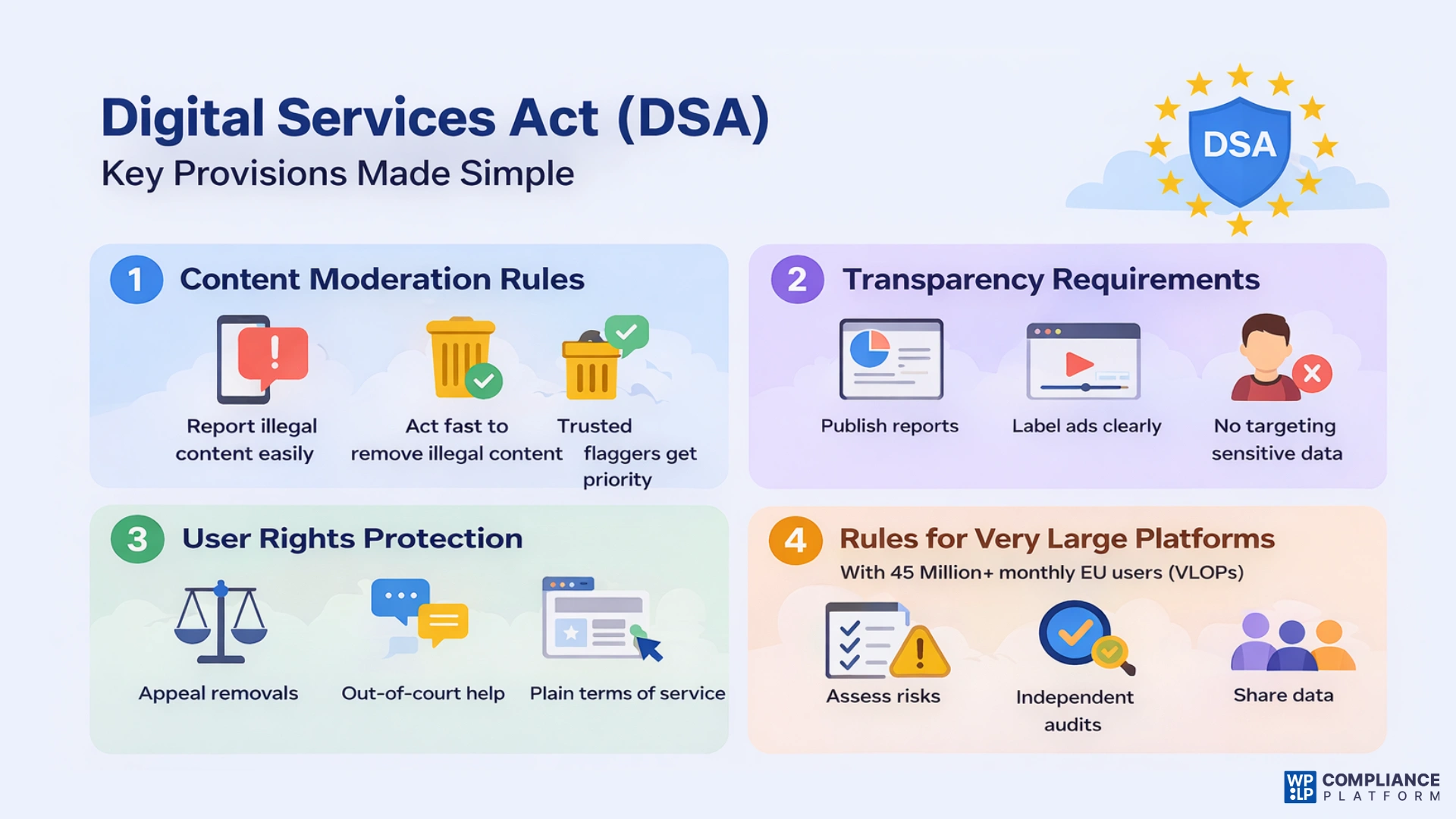
1. Content moderation rules
- There must be transparent and easy-to-use reporting options for users of Platforms for reporting illegal (unlawful) content.
- If Platforms know that illegal content exists on their site, in most instances, they have to immediately delete or disable any access to it.
- Users whose Content is deleted must receive notice that their content is deleted and a reason for deletion.
- Trusted flaggers (vetted organizations) are entitled to report content and have their reports handled as a priority.
2. Transparency requirements
- Platforms must publish regular transparency reports on their moderation actions
- Recommendation algorithms must be explained clearly to users
- Advertising must be clearly labeled, including who placed the ad and why it was shown to that user
- Targeted advertising based on sensitive personal data or directed at minors is prohibited
3. User rights protection
- Users have the right to appeal content removal decisions
- Out-of-court dispute settlement mechanisms must be available
- Platforms must offer at least one recommendation option not based on profiling
- Terms of service must be written in plain, accessible language
4. Special rules for Very Large Online Platforms (VLOPs)
- VLOPs (platforms with 45 million+ monthly EU users) face stricter obligations
- Must conduct annual systemic risk assessments for potential societal harms
- Subject to independent audits to verify compliance
- Must share data with researchers and authorities on request
- Designated VLOPs include Meta, Google, TikTok, Amazon, X (Twitter), and others
Who must comply with the EU’s Digital Services Act (DSA)?
The DSA applies to all digital service providers offering services to users in the EU, regardless of where the company is based. Compliance obligations scale with the size and type of the platform:
- Intermediary Services
ISPs (Internet Service Providers), DNS providers, and CDNs (Content Delivery Networks) are subject to the following basic obligations: A point of contact must be available, and the provider must therefore cooperate with law enforcement agencies and also produce basic transparency reports.
- Hosting Services
Web hosts and cloud storage must have notice and action mechanisms that allow users to identify and flag illegal content as well as provide a timely response to any request for removal.
- Online Platforms
Marketplaces, social media, and app stores must provide reporting tools for users, publish transparency reports about their reporting processes, have discernible labeling for advertisements, and create appeals processes for reported content.
- Very Large Online Platforms
VLOPs must have over 45 million EU users; therefore, they have the strictest obligations: conduct systemic risk assessments, undergo independent audits, share data with researchers, and provide enhanced transparency into their operations.
DSA penalties explained
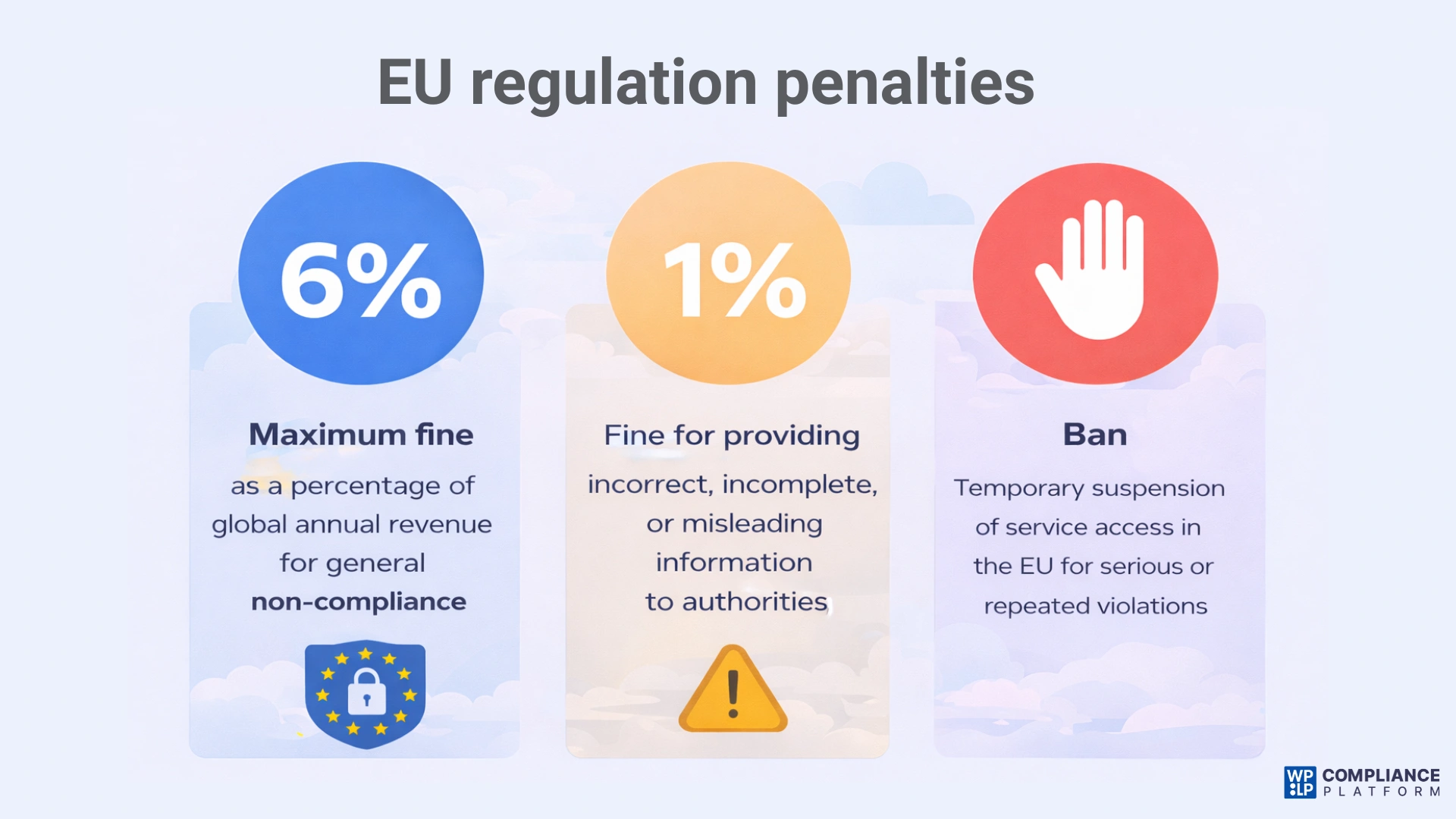
In addition to fines, non-compliant businesses face regulatory investigations that can disrupt operations, reputational damage that erodes user trust, and potential lawsuits from users whose rights were violated.
Common DSA compliance mistakes
- No content reporting system. Many platforms lack a clear, accessible way for users to flag illegal content. This is one of the DSA’s most basic requirements and one of the most commonly missed.
- Poor or inconsistent moderation processes. Removing content without documenting the decision, failing to notify users, or taking too long to act all create compliance gaps.
- No transparency reports. The DSA requires regular reporting on content moderation activities. Platforms that publish nothing — or publish reports that are too vague — risk enforcement action.
- Hidden ad targeting logic. Showing ads without disclosing why a user was targeted violates DSA transparency rules. Advertisers and platforms must both be named, and targeting criteria must be visible.
- No appeal mechanism. Every content removal decision must come with a way for users to challenge it. Platforms that offer no appeals process are non-compliant from day one.
Consequences of Non-Compliance with the DSA
Failure to comply with the Digital Services Act (DSA) can result in serious ramifications for businesses operating in the European Union.
Additionally, businesses face reputational damage from non-compliance, which can result in a loss of customer trust.
Non-compliance can also mean increased regulatory scrutiny and administrative resources, as well as increased compliance costs. Increased regulatory scrutiny can inhibit business activities, as businesses will need to make substantial changes to their business processes and, in some cases, suspend business operations all together.
Difference Between DSA and GDPR
The Digital Services Act (DSA) and the General Data Protection Regulation (GDPR) are two significant pieces of legislation within the European Union that aim to regulate the digital environment.
However, both of them focus on different aspects and have distinct purposes.
| Aspect | General Data Protection Regulation (GDPR) | Digital Services Act (DSA) |
|---|---|---|
| Scope | Personal data privacy and protection | Platform responsibility and content moderation |
| Objective | Ensures stringent data collection, processing, storage, and transfer requirements. | Focuses on content moderation, transparency, and accountability for online platforms. |
| Year of Introduction | 2018 | 2024 (full enforcement) |
| Applicability | Applies to any organization processing the personal data of EU residents, regardless of location. | Targets digital service providers, platforms, and intermediaries operating within the EU. |
| Key Focus | User consent, rights to data access, rectification, and deletion. | Protecting users from harmful content and ensuring fair marketplace practices. |
| Key Provisions | Consent, data rights, DPOs, DPIAs | Content removal, algorithm transparency, ad disclosure, user appeals |
| Enforcement | Non-compliance can result in fines of up to 4% of global annual turnover. | Penalties for non-compliance can reach up to 6% of global annual turnover. |
The GDPR and DSA both intersect in their goal of ensuring protected users and data; however, while the GDPR focuses on data privacy and protection, the DSA is about regulating content and making platforms responsible for creating a safe digital environment.
Both regulations must be understood and complied with by businesses in the EU. Utilizing both regulations together is a way to meet the rigorous data protection standards and digital service transparency required in the EU.
DSA vs DMA: What is the difference?
The DSA (Digital Services Act) regulates digital services. Its focus is primarily concerned with how service providers (digital) protect their users, including the moderation of the content on their platform, transparency in the use of their platform, and the rights of their users. All digital service providers are subject to this regulation, regardless of size.
The DMA (Digital Markets Act) is designed to regulate the competitive landscape among monopolists in the tech ecosystem. The DMA defines a “gatekeeper” company as a very large platform with a significant competitive market share. The DMA was created to prohibit anti-competitive behavior through self-preferencing and other means, such as blocking access to competing app stores.
Together, the DSA and DMA form the Digital Services Act Package, the EU’s comprehensive framework for a fair, safe, and competitive digital economy.
What is the Digital Service Act Package?
As we continue in the context of the Digital Services Act (DSA), we must recognize that the DSA is only one part of a more extensive legislative program also known as the Digital Services Act Package.
The broader Digital Services Act Package is focused on modernizing the EU’s digital services landscape to create a safe, realistic, and competitive online environment.
How Can Your Business Comply With DSA Regulations?
Ensuring your website or online platform complies with the Digital Services Act (DSA) is crucial for maintaining transparency, accountability, and user trust.
- Establish clear terms: Your service’s terms must be in clear language, explain your rules regarding how you will moderate content, and all users must be able to access them.
- Provide a method to report content: You must build or integrate a way for users to report illicit or damaging content. The method for reporting also must be easy for a user to find and easy for a user to use.
- Disclose how you target Ads: All ads that are shown to EU users must have a clear label that provides the identity of the advertiser and explains why a given user is receiving an advertisement.
While there are many ways to comply with DSA regulations, the best and most affordable way we recommend is to use legal compliance plugins such as WPLP Compliance Platform.
WPLP Compliance Platform allows you to create comprehensive and customized privacy policies that meet the DSA’s requirements. The plugin allows you to include detailed data collection, usage, sharing, and protection sections. This ensures users are well-informed about managing their data, aligning with the DSA’s emphasis on transparency and user rights.
Additionally, the plugin provides templates for terms and conditions, which can outline the rules and guidelines for using your website. These documents can specify the procedures for content moderation, clearly stating how illegal content is detected, reported, and removed, as mandated by the DSA.
FAQ
The DSA aims to create a safer, transparent digital space by enhancing accountability, protecting user rights, moderating illegal content, and ensuring fair practices among digital service providers and online platforms operating within the EU.
The DSA applies to digital service providers, including online platforms, hosting services, internet infrastructure providers, and very large platforms (VLOPs), as well as small businesses operating within or targeting users in the EU.
Non-compliance can lead to fines of up to 6% of global annual turnover, legal actions, operational disruptions, and reputational damage, severely impacting the business’s financial stability and customer trust.
The DSA focuses on content moderation, transparency, and platform accountability, while the GDPR emphasizes data privacy and protection. Both aim to safeguard users but address distinct aspects of the digital environment.
Conclusion
The Digital Services Act is reshaping how online platforms operate in Europe.
If your business interacts with EU users in any meaningful way, understanding and implementing DSA compliance is essential not just to avoid fines of up to 6% of global revenue, but to build trust, transparency, and long-term credibility with your audience.
Alongside the Digital Markets Act, the DSA reflects the EU’s commitment to creating a fair, secure, and competitive online space.
Further, if you liked this article, you can also consider reading:
- Oregon Consumer Privacy Act: An Overview of OCPA
- Best GDPR WordPress Plugins
- DPIA: An Overview of Data Protection Impact Assessment
Grab the WPLP Compliance Platform and stay compliant with all the global laws!