Summary
This article explains what legalese is, why it harms privacy and cookie policies, and how it negatively affects customer relationships.
It also shows how to rewrite legal jargon into clear, user-friendly language and maintain clarity over time. Clear, plain-language policies improve transparency, build trust, and help meet legal requirements.
Ever happen to you that while reading a legal policy, you felt like you had stepped into a courtroom? This happens because of legalese.
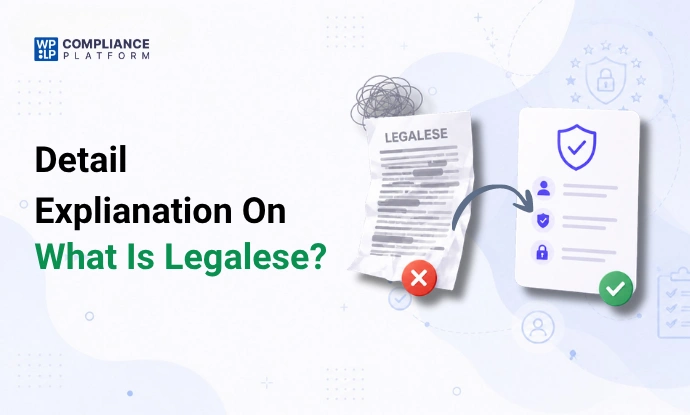
Legalese is defined as overly complicated legal language. Like the kind of words you often see in contracts and policies, which are hard for any normal person to understand.
For website owners, this is a real problem. When visitors can’t easily understand your privacy policy or consent notice, they’re more likely to lose trust, abandon your site, or refuse consent altogether. Worse, unclear language can increase legal risk, many privacy laws now require information to be presented in clear, plain language.
Today’s users expect clarity. They want straightforward policies that tell them exactly what happens with their data, without forcing them to decode paragraphs of legal jargon.
What is legalese?
Legalese is simply the overly complex, specialised language used primarily by lawyers and government officials. Long, convoluted sentences, Latin phrases, technical jargon, and unnecessary repetition characterise it.
Legalese is also known as:
- Lawyer’s Language
- Legal Speak
- Legal Jargon
- Legal English
- Officialese
- Gobbledegook
While it aims for technical precision in a courtroom, it’s terrible for everyday communication. Think of it as the opposite of plain language.
Legalese was originally written for lawyers talking to other lawyers, not for regular people trying to understand how a website handles their data.
And that’s exactly the issue, businesses think that using legal jargon in their policies makes their policy more professional. But your visitors feel confused, overwhelmed, or even suspicious. They don’t know what they’re agreeing to, and honestly, they shouldn’t need a law degree just to understand your website’s rules.
That’s why simplifying your language isn’t just good practice, it’s the key to building trust, improving transparency, and keeping your policies user-friendly and compliant.
If you want to create a jargon-free privacy page, you can use the WPLP Compliance Platform.
Legalese Example
Below you can see a legalese example.
This text in simple language means that “By using this site, you agree to these terms.”
This text in simple language means that “If you misuse the service and it causes problems, you’re responsible, not us.”
Why Legalese Is a Problem for Website Policies
For a WordPress site owner, blogger, or small business, using complicated legal language creates several distinct problems that directly impact your online success.
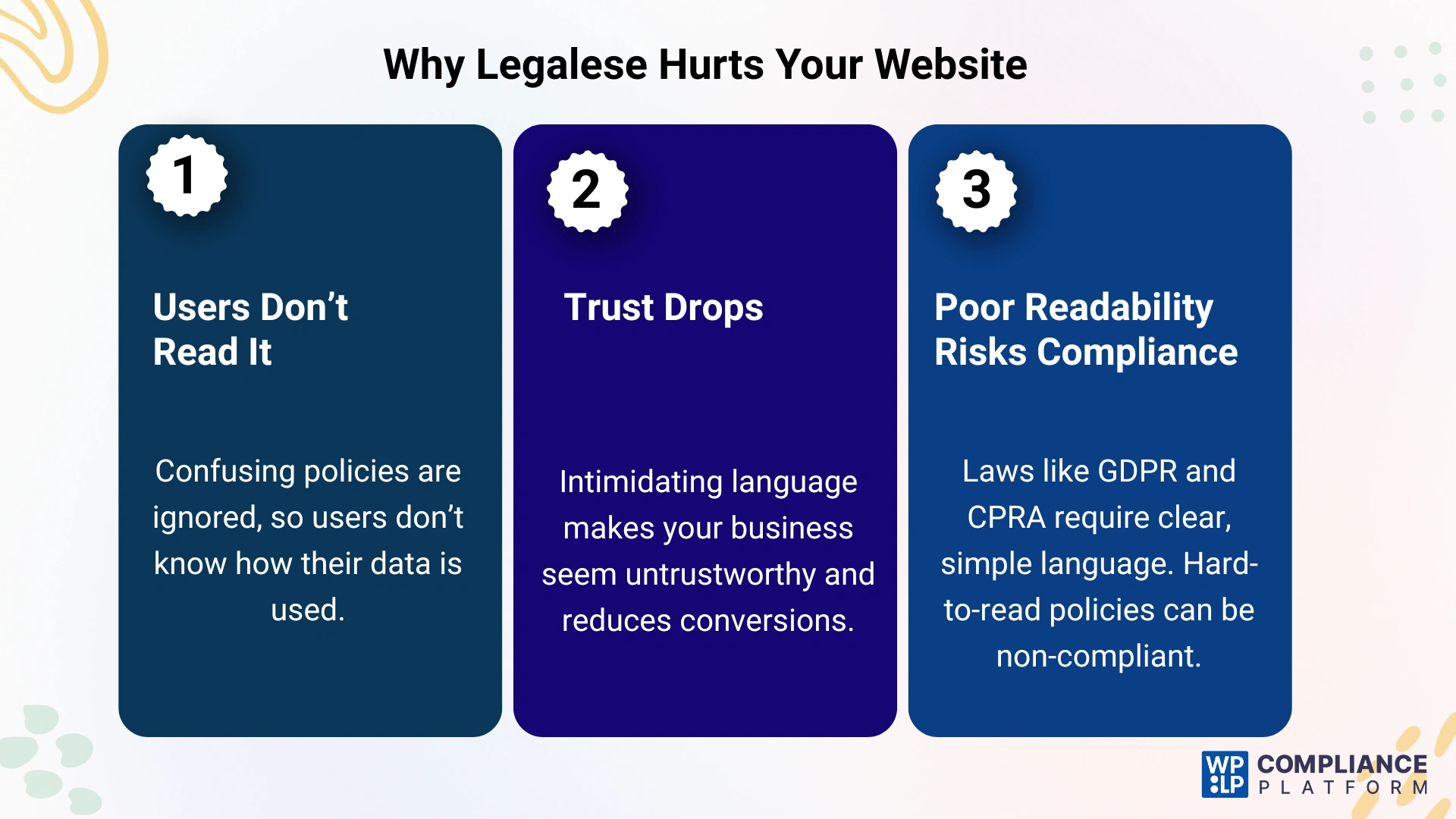
1. Users Don’t Read It
When your policies are not easily readable by consumers, they are likely to overlook them. If users are ignoring your Privacy Policy due to its difficulty in reading and understanding, then you lose the chance to convey how you collect and use their personal data, since they do not understand what you are trying to disclose.
2. Trust Decreases When Policies Feel Intimidating
Trust is built upon clear communication of your policies. If people view your policies as confusing and complicated, then users will question your motives.
When a policy is needlessly complicated, potential customers will view the company issuing the policy as being less than trustworthy. This will have a direct impact on your conversion rate and the number of subscriptions you receive.
3. Poor Readability Can Fail Compliance Expectations
This is the most critical point: clarity is often a compliance requirement.
Major privacy laws worldwide explicitly require the language used in policies to be clear and understandable:
- GDPR (General Data Protection Regulation): Requires that information provided to data subjects must be “concise, transparent, intelligible and easily accessible form, using clear and plain language.”
- CPRA (California Privacy Rights Act), Virginia CDPA, Utah UCPA, etc. require policies to be transparent and accessible to the average consumer.
If a policy is deemed intentionally confusing or too complex for the target audience, regulators could argue that you have not fulfilled your legal obligation for transparency. Your policy may be legally accurate, but non-compliant if it’s not clear.
How Does Legalese Impact Customer Relationships and Trust?
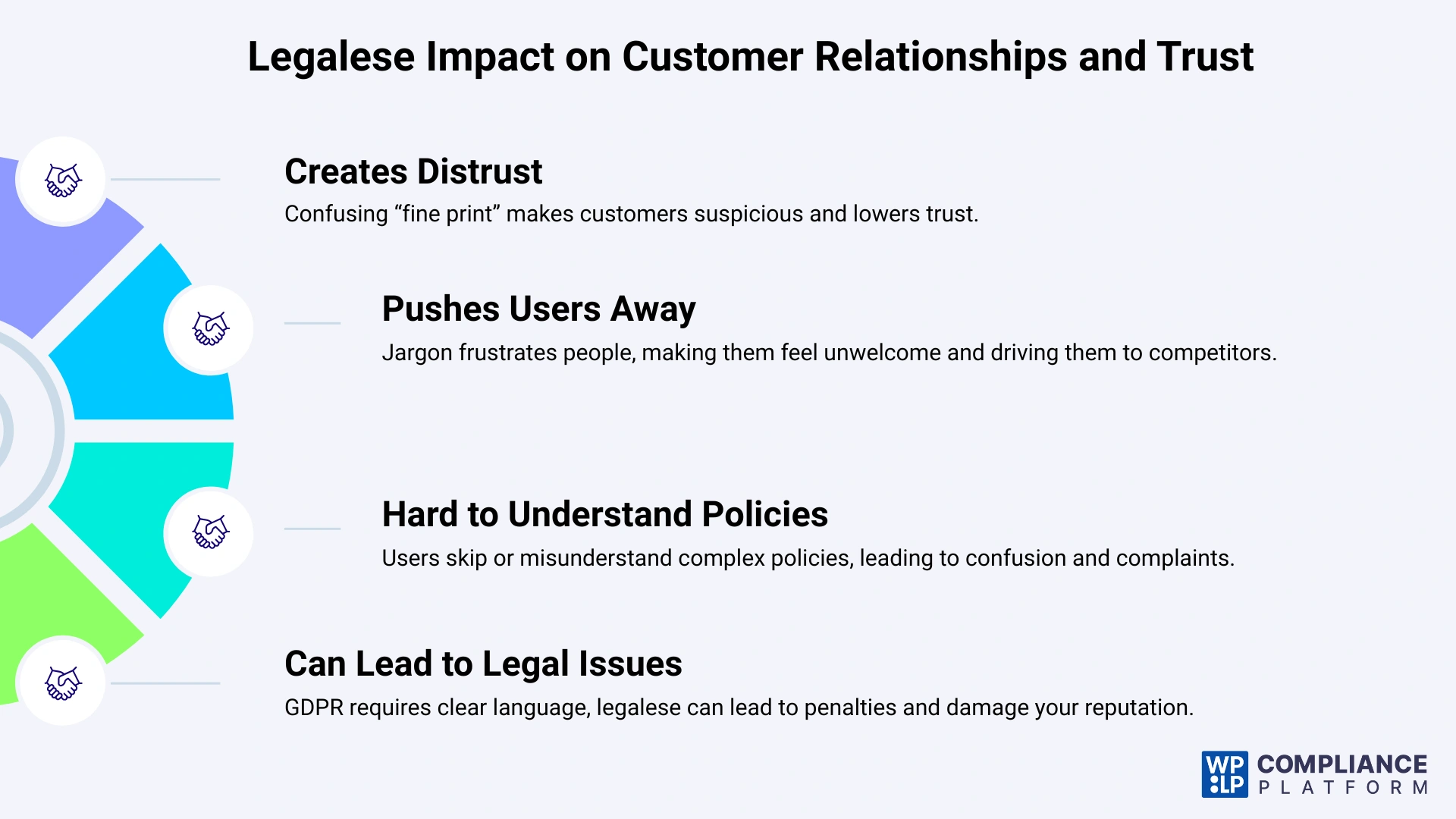
Yes, legalese does impact your website-client relationship. Here are the specific ways legalese negatively impacts customer relationships and erodes trust:
1. It Makes Customers Distrust You
The legal jargon used in business language often brings to mind phrases like “fine print”.
Usually, fine print is supposed to highlight the important details within a contract, but it can also cause suspicion in a customer when they see legal jargon.
Customers may feel that the company is hiding something, which damages their perception of the company’s credibility and trustworthiness, as they believe that clear communication builds trust.
If a company can’t explain its data practices and other basic rules in plain language, it creates uncertainty for customers, who may hesitate to purchase, sign, or provide personal information.
2. It Pushes Customers Away
Business language includes many formal, technical terms that create a sense of distance between a business and its customer.
Legal wording pushes customers away from the businesses they are dealing with.
This creates a lot of frustration for customers because it can quickly change their feelings from positivity to negativity.
Customers also feel like the company is being condescending or attempting to sound superior to them, and this can drive them away to competitors who communicate in simpler language.
3. It Makes Policies Hard to Understand
Policies exist to help customers understand their rights and responsibilities, but legalese does the opposite. When terms are too long or filled with confusing phrases, users simply skip them or click “I agree” without reading.
This leads to misunderstandings, complaints, and disputes because customers weren’t able to clearly understand the rules. In some cases, it may even increase the company’s liability.
4. It Can Cause Legal Problems
Using complicated language in communication creates barriers for customers. It negatively affects customer service and can result in increased liability for the company.
The General Data Protection Regulation (GDPR) has clear regulatory requirements for businesses to clearly explain their privacy practices using plain and simple terms. If your company does not provide transparent language, regulators will treat it as a potential violation of compliance.
Furthermore, businesses that use complicated legal language in their policies and procedures are likely to receive penalties and have their reputation tarnished due to the perception that they are not prioritising clear communications or complying with regulations.
How to Rewrite Legalese Into User-Friendly Language
Transitioning from legal speak to plain language policies doesn’t require a law degree, just a shift in writing habits. Follow this simple framework to start creating user-friendly terms and conditions and policies:
Give a Simple Framework:
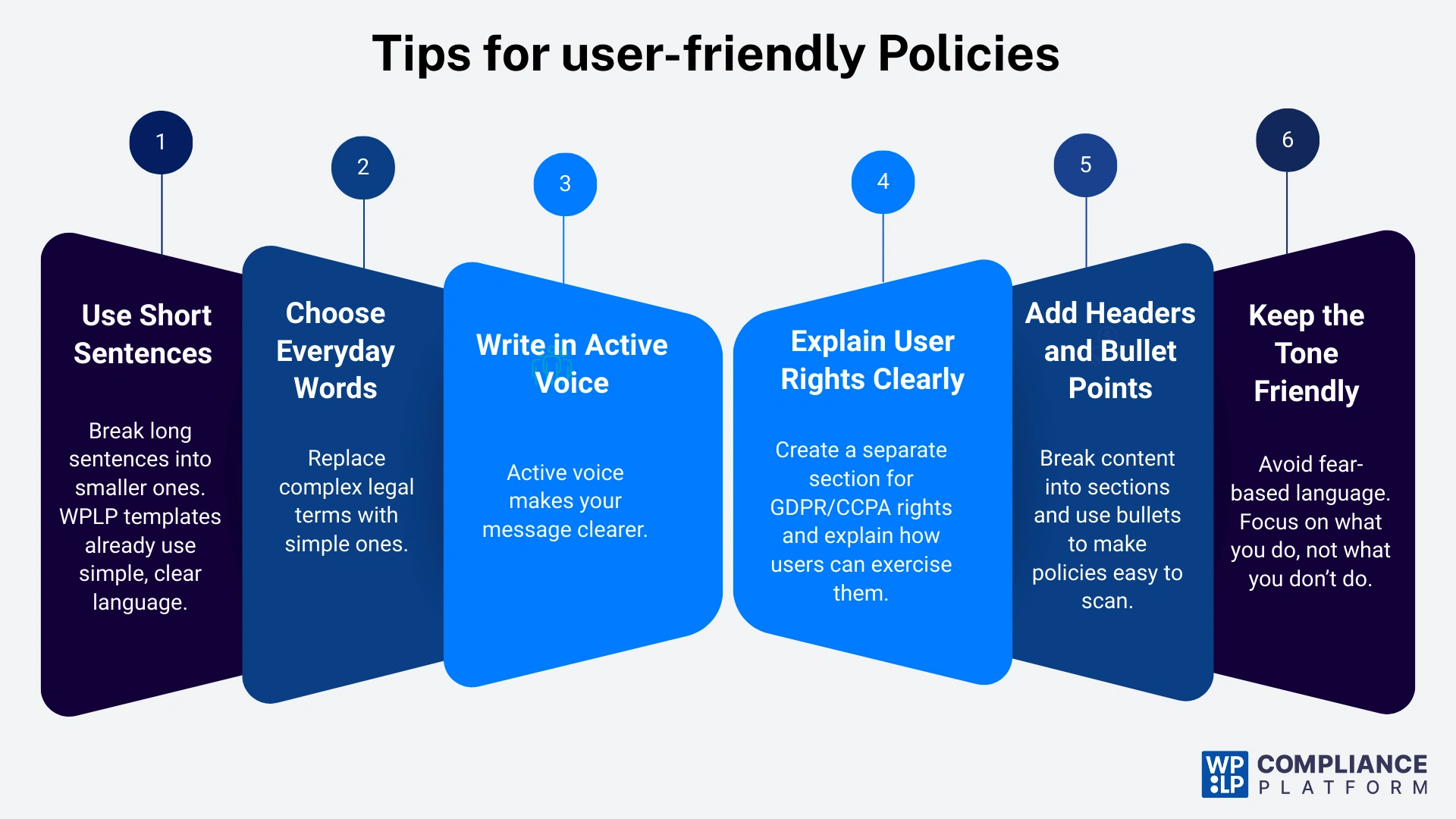
1. Simplify sentences
Break up long, complex sentences into two or three simpler ones. Focus on one idea per sentence.
For that, you can use WPLP Compliance Platform templates (for privacy, cookie policy, CCPA/CPRA, refund policy, etc.) that are already written in clear, simple language, effectively tackling legalese before it even appears.
2. Replace words
Replace high-level legal terms with common synonyms. For instance, use “before” instead of prior to, and “start” instead of commence.
Try to use more active voice in your policies.
3. Structure content
When outlining a user’s rights (e.g., under GDPR or CCPA), dedicate a clear section to them. Use simple language to explain how a user can exercise those rights, not just that they exist.
Or you can simply generate the legal pages using the WPLP Compliance Platform.
4. Review tone
This is the easiest way to improve readability. Break the document into logical, scannable sections using clear headers. Use bulleted lists to present rights, responsibilities, or types of data collected.
5. Avoid Fear-Based Tone
Policies should be informative and authoritative, not accusatory or fear-inducing. Focus on what you do (e.g., “We only share your data…”) rather than what you don’t do (e.g., “We do not share your data unless…”).
Tips to Keep Policies Clear Over Time
Legal policies aren’t static documents; they require maintenance. A policy can start clear and drift back into legalese if you’re not careful.
- Review When Adding New Tools: Whenever you add a new script or app, update your Privacy Policy to clearly explain what data it collects and why.
- Don’t Copy Other Policies: Another company’s policy won’t match your practices. Copying can cause legal issues and confuse users with unnecessary legalese.
- Check Readability: Use tools like Flesch-Kincaid (available in most word processors) to check the readability of your policy.
- Keep Consent Language Clear: Make cookie banners and consent notices short, direct, and free of ambiguity.
Remember, tools like WPLP simplify edits as your site evolves, helping you manage policy updates without reintroducing legal jargon.
FAQ
Yes. Regulations require policies to be clear and readable. Complex language may be considered non-compliant even if the policy is technically accurate.
Use short sentences, everyday words, active voice, headers, bullets, and explain user rights clearly. Tools like WPLP templates help simplify policies automatically.
No. Copying can lead to legal issues and may not reflect your business practices. Always create policies tailored to your website.
No, legalese is not recommended under GDPR, and your website can be non-compliant if you use it.
Conclusion
Legalese makes website policies hard to read and understand. It confuses users, reduces trust, and can even create legal compliance risks under laws like GDPR, CPRA, or UCPA.
Customers may skip reading your policies, feel intimidated, or misinterpret their rights, which can hurt conversions and damage your brand’s credibility.
Simplifying your policies with short sentences, everyday words, active voice, headers, and bullets improves clarity. Clearly explain user rights, keep consent language straightforward, and avoid fear-based tones.
Tools like WPLP templates help ensure policies remain user-friendly while staying compliant, especially as your site evolves and new tools are added.
If you like this article, consider reading:
- How to Create a Cookie Policy For Your Website
- How to Add Cookie Consent Banner in WordPress From Scratch
- How to Implement IAB TCF 2.3 in WordPress
Disclaimer: This article is for informational and reading purposes only and does not constitute legal advice.