Summary
– Better protect personal data
– Reduce compliance risks
– And, make informed decisions about your data collection practices.
This knowledge can help you stay ahead of evolving data privacy regulations worldwide while building trust with your users.
Are you aware of how many data privacy laws there are around the world? In a world where our every click, swipe, and search leaves a trail of data behind, privacy has taken on a whole new meaning.
These data protection laws serve as a shield, safeguarding your personal information and regulating its use.
Data privacy regulations have become more necessary due to the speed at which technology is developing and the volume of personal data being gathered.
This article will explore the significance and global presence of data privacy laws and explain why they are essential in today’s digital age.
What is Data Privacy Law?
Data privacy laws, also known as data protection laws, aim to protect individuals’ personal information. These laws govern data collection, storage, processing, and sharing to ensure that individuals control how their personal information is used.
Data privacy laws require organizations and businesses to handle personal data responsibly and ethically, emphasizing transparency, consent, and data security.
Key elements of data privacy laws often include:
- Consent: Organizations must obtain valid consent before collecting or processing personal information when consent is required by law. Consent should be informed, specific, and freely given.
- Purpose Limitation: Personal data should only be collected for legitimate purposes and used only for the reasons communicated to individuals at the time of collection.
- Data Minimization: Organizations should collect only the data necessary to achieve a specific purpose and avoid gathering excessive information.
- Data Security: Businesses must implement appropriate technical and organizational measures to protect personal information from unauthorized access, loss, or misuse.
- Data Subject Rights: Most privacy laws provide individuals with rights such as accessing, correcting, deleting, or transferring their personal data.
- Accountability and Governance: Organizations are expected to maintain compliance programs, document data practices, and demonstrate accountability for how personal information is managed.
Adhering to data privacy laws is crucial for organizations to earn customer trust and maintain ethical data management standards.
Why Do We Need Data Privacy Laws?
Data privacy laws are essential due to the increasing reliance on digital platforms and the resulting surge in data collection and processing.
Without regulations, personal data can be misused and abused, leading to privacy breaches, identity theft, and cybercrime.
High-profile data breaches affecting millions of users have shown the importance of clear privacy standards and stronger accountability for organizations that collect personal information.
Data privacy laws ensure that businesses handle personal data transparently, securely, and legally, safeguarding individuals’ privacy and trust.
8 Major Data Privacy Laws Comparison Table
The table below shows how major data privacy regulation frameworks differ across key compliance requirements.
| Law | Region | Effective Date | Notable Penalty |
| GDPR | European Union | 2018 | Up to €20 million or 4% of annual global turnover |
| CPRA | California | 2023 | Enforcement by California Privacy Protection Agency |
| CCPA | California | 2020 | Up to $7,500 per intentional violation |
| LGPD | Brazil | 2020 | Up to 2% of revenue capped by law |
| PIPL | China | 2021 | Up to 5% of annual revenue |
| DPDP Act | India | 2023 | Significant monetary penalties for violations |
| VCDPA | Virginia | 2023 | State enforcement actions |
| PIPEDA | Canada | 2000 | Regulatory enforcement and corrective actions |
Major Data Privacy Laws Around the World
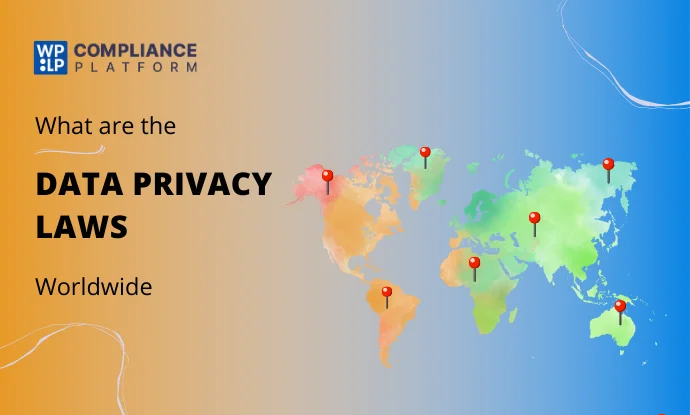
Data privacy laws vary significantly from country to country, reflecting each nation’s unique cultural, political, and economic considerations. These regulations protect individuals’ privacy and secure their data in a digital world.
Some countries prioritize strict consent for data collection, while others focus on clear guidelines for data retention and sharing.
Adhering to data privacy laws is essential for international businesses to build customer trust and accountability in handling sensitive information.
Let’s look at some of the data privacy laws around the world.
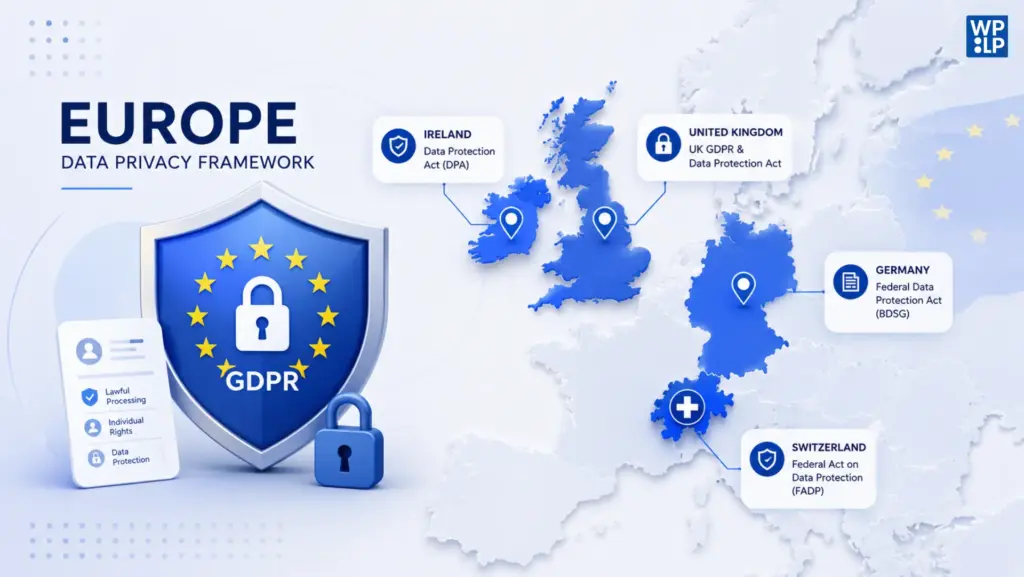
Europe Data Privacy Framework
1. EU’s General Data Protection Regulation (GDPR)
The General Data Protection Regulation (GDPR) is a regulation that governs the processing of personal data belonging to European Union residents.
It’s widely regarded as one of the world’s most influential data privacy regulation models and has formed the basis for many privacy laws in many other regions.
The GDPR, implemented in 2018, imposes stringent rules on how businesses handle personal data. These rules include the requirement for transparency, purpose limitation, and data reduction. Among many data privacy laws worldwide, this is the strictest one.
Furthermore, the regulation grants individuals significant rights over their data, such as the capacity to see, modify, and delete information. The GDPR imposes steep fines for noncompliance, highlighting the need for data protection and privacy in the digital age. Organizations can face penalties of up to €20 million or 4% of their annual global turnover, whichever is higher.
Businesses outside the European Union may also be required to comply with GDPR if they offer products or services to EU residents or monitor their behavior online.
2. Germany Federal Data Protection Act (BDSG)
The Federal Data Protection Act (BDSG) is a national counterpart to the General Data Protection Regulation (GDPR) and controls data processing activities within Germany.
The BDSG contains data protection rules for transfers and the appointment of data protection officers. It provides guidance for businesses in Germany to comply with GDPR standards.
3. Irish Data Protection Act (DPA)
The GDPR is supplemented by the Irish Data Protection Act (DPA) to further govern data protection practices in Ireland.
The DPA offers extra rules on data processing, with EU data protection authorities, and incorporates GDPR obligations into Irish law.
The law reaffirms Ireland’s commitment to protecting data privacy rights by requiring nationwide businesses to respect the highest levels of data protection and transparency per EU data protection principles.
4. UK Data Protection Act (DPA)
To govern data protection and privacy legislation in the United Kingdom, the UK GDPR and the UK Data Protection Act (DPA) work together to regulate how personal information is processed.
The DPA outlines requirements for processing specific categories of personal data, fair and legal processing rules, and data subjects’ rights.
Following Brexit, the United Kingdom operates under UK GDPR, which is based on the EU GDPR but functions as a separate legal framework. Organizations operating in both the UK and the EU may need to comply with both regimes.
5. Swiss Revised Federal Act on Data Protection (FADP)
The revised Swiss Federal Act on Data Protection (FADP) governs how public and commercial organizations process personal data in Switzerland.
The FADP emphasizes data security, consent, and transparency while harmonizing Swiss data protection regulations with worldwide norms.
The law mandates data controllers to safeguard data security and integrity, empowering individuals to control the sharing of their personal information. To guarantee that personal data is processed lawfully in Switzerland, data protection authorities monitor compliance and enforce the FADP.
North America Data Privacy Landscape
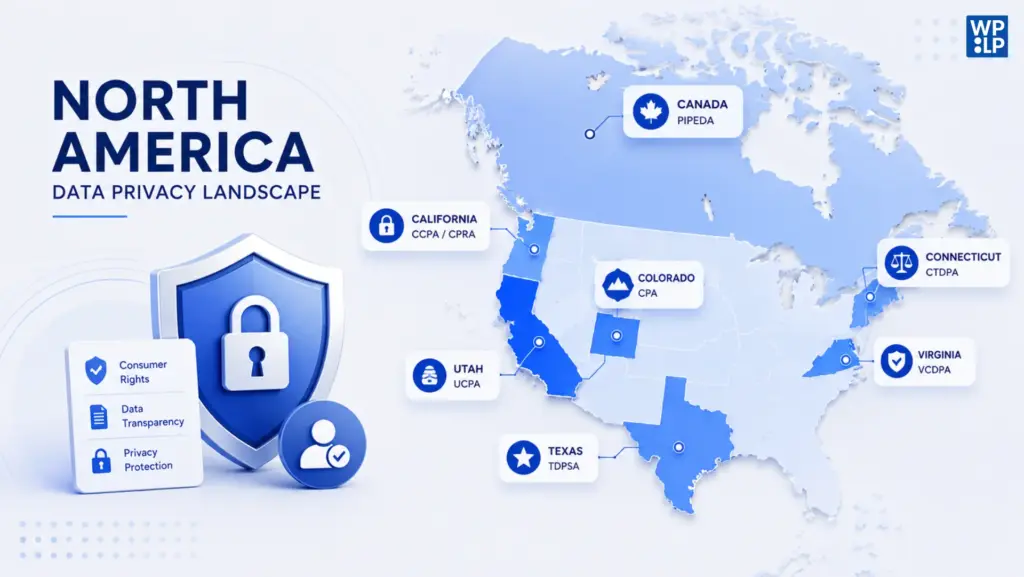
6. California Privacy Rights Act – US Privacy Law
Californians’ data privacy rights are further enhanced under the California Privacy Rights Act (CPRA), which builds upon the California Consumer Privacy Act (CCPA).
The CPRA, approved by voters in November 2020, took effect in 2023. It allows individuals to control how their personal information is used by establishing the California Privacy Protection Agency.
This law reflects California’s commitment to giving people more control over their personal information for their data practices.
7. California Consumer Privacy Act (CCPA)
Another important law that impacts your website is the California Consumer Privacy Act (CCPA). This is a significant data privacy law in California that grants consumers various rights over their personal information.
The California Consumer Privacy Act (CCPA) was signed into law in 2018 and became effective on January 1, 2020. It grants individuals the right to access the information collected about them and opt out of selling their information.
The law generally applies to certain businesses that meet revenue or data processing thresholds, making it particularly relevant for organizations handling large volumes of consumer data.
Businesses must obtain consent for data collection where required, disclose data practices, and implement data security measures in compliance with the law.
8. Virginia’s Consumer Data Protection Act (VCDPA)
Virginia’s Consumer Data Protection Act (VCDPA) is a state-level data privacy legislation that aims to enhance consumer data protection and privacy rights within the state.
Enacted in 2021, the VCDPA imposes requirements on businesses that handle Virginia residents’ personal information. These include transparency in data practices, obtaining consumer consent for data processing, and implementing data security measures.
The VCDPA grants Virginia residents specific rights over their data, such as access, correction, deletion, and opt-out of the sale of their personal information. This is in line with the growing trend of state-level data privacy laws in the United States.
9. Colorado Privacy Act (CPA)
The Colorado Privacy Act (CPA), effective from July 2023, provides Colorado residents with rights regarding their personal data and places obligations on organizations that process consumer information.
The law gives consumers the right to access, correct, delete, and obtain copies of their personal data. It also allows individuals to opt out of targeted advertising, certain profiling activities, and the sale of personal information.
The CPA is part of the growing movement toward state-level privacy legislation in the United States.
10. Connecticut Data Privacy Act (CTDPA)
The Connecticut Data Privacy Act (CTDPA), effective from July 2023, establishes privacy rights for Connecticut residents and responsibilities for businesses processing personal data.
The law grants consumers rights to access, correct, delete, and obtain copies of their data while requiring organizations to maintain transparency regarding their data processing practices.
The CTDPA reflects the increasing focus on consumer privacy protections across US states.
11. Utah Consumer Privacy Act (UCPA)
The Utah Consumer Privacy Act (UCPA), effective from December 2023, establishes privacy rights for Utah residents and compliance obligations for covered businesses.
The law requires organizations to provide transparency around data collection and allows consumers to access their personal data, request deletion in certain circumstances, and opt out of specific data processing activities.
The UCPA is generally considered more business-friendly than some other state privacy laws while still providing meaningful privacy protections.
12. Texas Data Privacy and Security Act (TDPSA)
The Texas Data Privacy and Security Act (TDPSA), effective from July 2024, expands privacy protections for Texas residents and establishes compliance obligations for organizations operating in the state.
The law provides rights related to accessing, correcting, deleting, and obtaining copies of personal information. It also requires businesses to maintain reasonable security measures and transparency regarding data practices.
The TDPSA further demonstrates the rapid expansion of state privacy legislation throughout the United States.
13. Personal Information Protection and Electronic Documents Act (PIPEDA)
Canada’s federal privacy law, the Personal Information Protection and Electronic Documents Act (PIPEDA), regulates how private sector businesses gather, use, and disclose personal data.
In 2000, PIPEDA was passed to set guidelines for data collection consent, limit data use, and protect personal information from unauthorized access.
PIPEDA reflects Canada’s commitment to protecting privacy rights while balancing businesses’ obligations to utilize personal data responsibly.
Canada is also working toward broader privacy reform through the proposed Consumer Privacy Protection Act (CPPA), which is expected to modernize the country’s privacy framework.
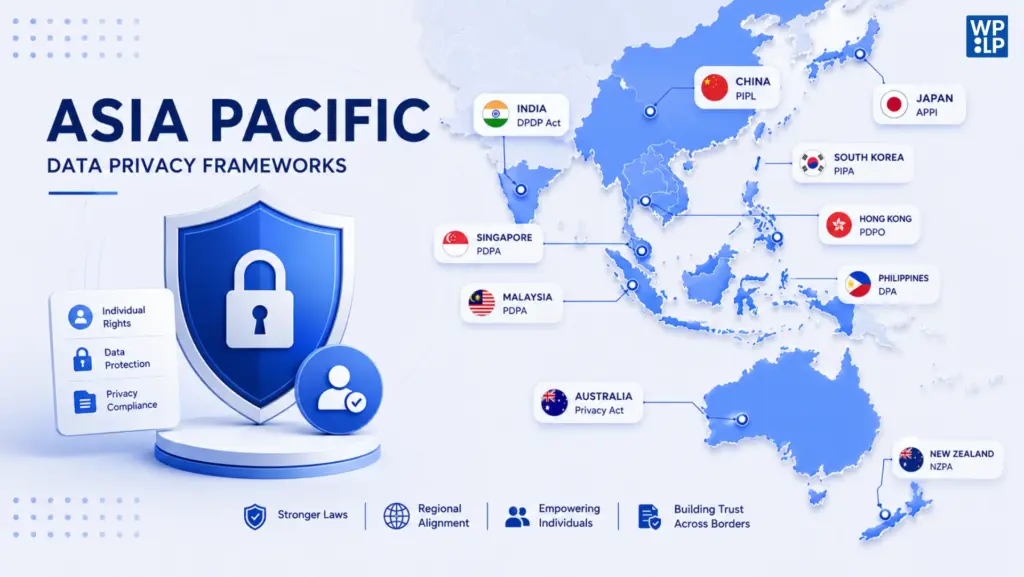
Asia Pacific Data Privacy Frameworks
The Asia Pacific region has seen rapid growth in data privacy regulation, with several countries introducing comprehensive privacy laws in recent years.
14. Thailand’s Personal Data Protection Act (PDPA)
Thailand has enacted the Personal Data Protection Act (PDPA) to regulate the country’s collection, use, and sharing of citizens’ personal information.
Effective as of 2020, this act establishes rights for data subjects, outlines best practices for managing data, and requires processors to safeguard the data.
The law aims to promote trust and align Thailand’s data protection regulations with international standards.
15. Japan’s Act on the Protection of Personal Information (APPI)
The Act on the Protection of Personal Information (APPI) of Japan governs how organizations and businesses in Japan handle personal information.
The APPI, enacted in 2005 and revised in 2015, provides guidelines for handling personal data to protect privacy rights. Significant amendments that became fully effective in 2022 introduced stronger requirements for data breach reporting, cross-border data transfers, and individual rights.
The law strongly emphasizes data security, informed consent, and individuals’ rights to access and amend data, reflecting Japan’s dedication to protecting personal information in the digital age.
16. New Zealand’s Privacy Act (NZPA)
The New Zealand Privacy Act (NZPA) enhances individual privacy and safeguards by regulating organizations’ gathering, use, and sharing of personal information.
The NZPA, enacted in 2020, updates other New Zealand privacy laws with mandatory data breach reporting and increased regulatory authority.
The law emphasizes responsibility and openness, reflecting New Zealand’s commitment to protecting privacy rights in an increasingly data-driven society.
17. Philippines’ Data Privacy Act (DPA)
The Philippines’ Data Privacy Act of 2012 offers a thorough framework for the nation’s personal data protection laws. The DPA was created to protect the fundamental right to privacy.
It establishes guidelines for processing personal data, guarantees transparency in data handling procedures, and creates the National Privacy Commission to monitor adherence.
The law gives people control over their data and requires businesses to implement security measures to guard against illegal access to or disclosure of personal data.
18. South Korea’s Personal Information Protection Act (PIPA)
The Personal Information Protection Act 2012 (PIPA) of South Korea regulates the gathering, use, and transfer of personal information inside the nation.
PIPA provides guidelines for obtaining consent, informing individuals about data processing activities, and safeguarding personal data security for fair and transparent data processing.
The law holds companies responsible for following appropriate data management procedures while attempting to balance the advantages of using data and the defense of people’s right to privacy.
19. Singapore’s Personal Data Protection Act (PDPA)
The Personal Data Protection Act (PDPA) of Singapore lays out a strict framework for data protection that governs how businesses handle personal information.
The PDPA, passed in 2012 and revised in 2020, lays out guidelines for gathering, utilizing, and disclosing personal data.
The law enforces data protection standards through fines for non-compliance, promoting responsible data governance, and giving individuals authority over their data.
20. Malaysia Personal Data Protection Act (PDPA)
Malaysia’s Personal Data Protection Act (PDPA) regulates how individuals and companies process personal data there.
The PDPA, enacted in 2013, mandates the fair and legal treatment of personal data and upholds subjects’ data protection rights.
The PDPA aims to enhance consumer confidence, promote responsible data management, and facilitate secure data transmission in Malaysia’s digital economy.
21. Hong Kong Personal Data (Privacy) Ordinance (PDPO)
The Hong Kong Personal Data (Privacy) Ordinance (PDPO) regulates how people and organizations in Hong Kong handle personal data.
The PDPO, revised in 2020, sets out data protection principles, data subject rights, and practice requirements.
To ensure compliance and address data privacy issues, the Office of the Privacy Commissioner for Personal Data oversees regulations that balance privacy rights with lawful data usage.
22. Digital Personal Data Protection Act (DPDP)
India’s Digital Personal Data Protection Act (DPDP), enacted in August 2023, aims to protect people’s right to privacy and regulate how personal data is processed.
The law establishes obligations for data fiduciaries, rights for individuals, and penalties for non-compliance. It also introduces requirements relating to consent, data processing, and the protection of digital personal data.
The DPDP Act represents India’s most significant privacy legislation and provides a comprehensive framework for personal data protection in the country.
23. China’s Personal Information Protection Law (PIPL)
China’s Personal Information Protection Law (PIPL) is one of the most significant privacy regulations introduced in recent years and governs how organizations collect, process, store, and transfer personal information relating to individuals in China.
Effective from November 2021, PIPL establishes strict requirements around consent, transparency, cross-border data transfers, and the handling of sensitive personal information.
The law grants individuals rights over their personal data while imposing substantial obligations on businesses. Organizations that violate PIPL can face significant penalties, including fines that may reach up to 5% of annual revenue in serious cases.
Middle East Data Protection Laws
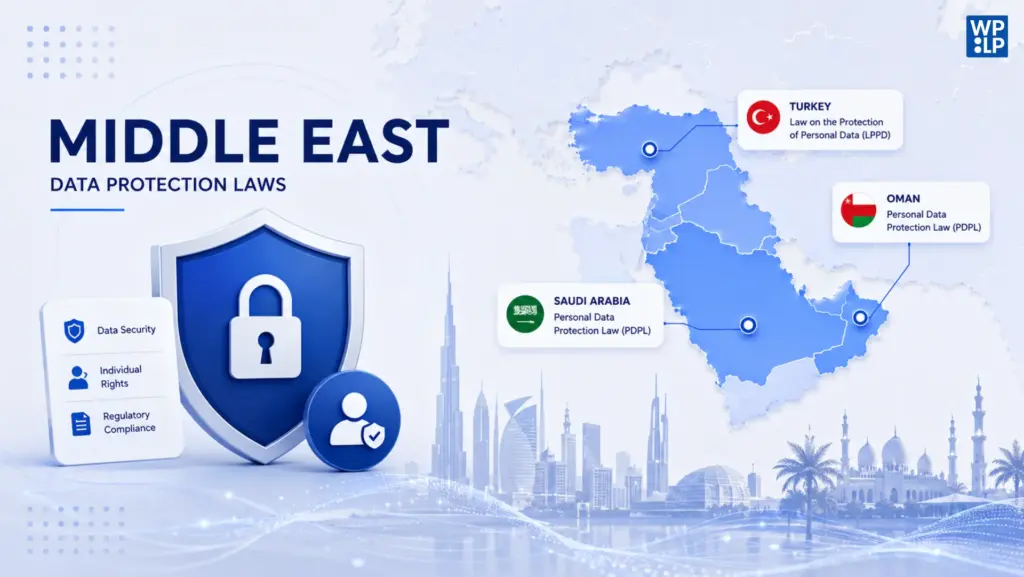
24. Turkey’s Law on the Protection of Personal Data (LPPD)
Turkey’s Law on the Protection of Personal Data (LPPD) attempts to protect people’s right to privacy and regulate how public and private organizations manage personal data.
The LPPD, effective since 2016, sets rules for data processing, protects data subjects’ rights, and imposes duties on data controllers and processors.
Turkey’s data law emphasizes transparency, proportionality, and security to build trust in the digital ecosystem.
25. Oman’s Personal Data Protection Law
The Kingdom of Oman’s Personal Data Protection Law is intended to control the processing of personal data and protect people’s right to privacy.
The law outlines requirements for data controllers and processors, rights for data subjects, and fair and legal data processing practices.
To foster responsible data management practices in Oman’s digital environment and increase trust in data processing activities, it highlights the significance of data security and confidentiality.
26. Saudi Arabia’s Personal Data Protection Law (PDPL)
The Kingdom of Saudi Arabia’s Personal Data Protection Law (PDPL), enacted in 2021, aims to control how personal data is processed and safeguard people’s right to privacy.
The law outlines obligations for data controllers and processors, requirements for legitimate data processing, and data subject rights.
The PDPL intends to guarantee the proper treatment of personal information and foster confidence in data processing methods within Saudi Arabia’s digital environment by highlighting the significance of data privacy and security.
Latin America Data Privacy Frameworks
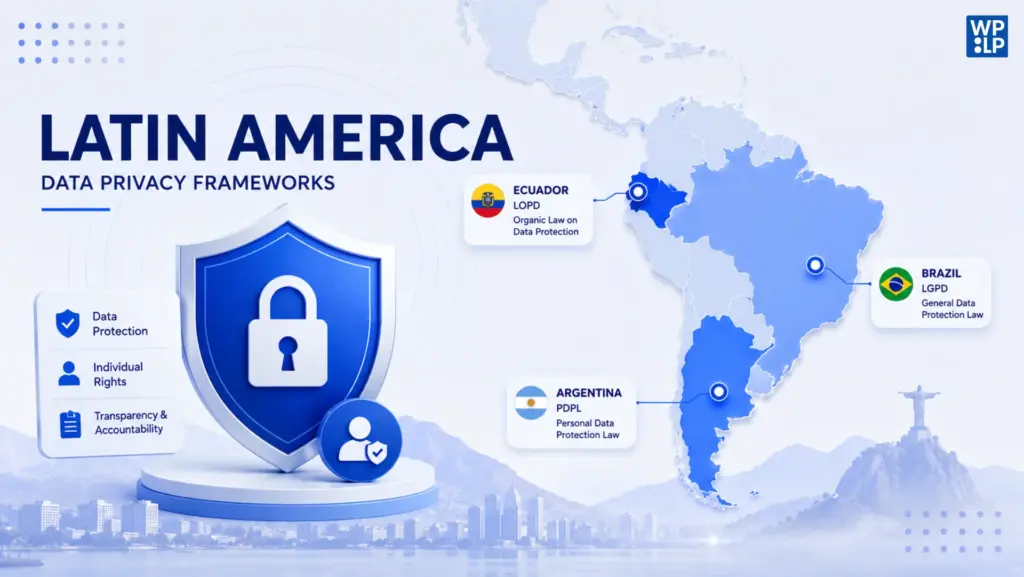
27. Brazil’s Lei Geral de Proteção de Dados (LGPD)
Inspired by the GDPR, Brazil’s Lei Geral de Proteção de Dados (LGPD) is a comprehensive data protection law that protects the personal information of its residents.
The LGPD, passed in 2018 and came into full effect in 2020, intends to safeguard people’s right to privacy. It also provides data processing guidelines and guarantees openness in data practices.
The law allows individuals to control their information. Organizations must implement data protection measures and appoint Data Protection Officers (DPOs) to ensure compliance.
Organizations may face penalties of up to 2% of their revenue in Brazil, subject to statutory limits, for serious violations.
28. Argentina’s Personal Data Protection Law (PDPL)
Argentina’s Personal Data Protection Law (PDPL), passed in 2000 and revised in 2004, offers a thorough framework for safeguarding personal information in Argentina.
The law lays out obligations for data controllers and processors to guarantee the fair and transparent treatment of personal information and requirements for the lawful processing of personal data and the rights of data subjects.
The PDPL emphasizes data subjects’ rights and accountability in data processing operations, bringing Argentina’s data privacy regulations into line with international best practices.
29. Ecuador – Ley Orgánica de Protección de Datos Personales (LOPD)
The Ley Orgánica de Protección de Datos Personales (LOPD) in Ecuador is the country’s fundamental data protection law regulating personal data processing and upholding individuals’ privacy rights.
Enacted in 2021, the LOPD establishes principles for the lawful and fair handling of personal information, data subject rights, and obligations for data controllers and processors. The law emphasizes transparency, consent, and data security in data processing activities to ensure the confidentiality and integrity of personal data.
The LOPD aims to protect individual privacy rights and promote responsible data management practices in Ecuador’s digital landscape by aligning with international data protection standards.
Africa Data Privacy Framework

30. South Africa’s Protection of Personal Information Act (POPIA)
The Protection of Personal Information Act (POPIA) of South Africa is a comprehensive data protection law that governs the country’s handling of personal information.
POPIA, enacted in 2013 and fully implemented in 2020, lays down guidelines for responsible data processing, protects the rights of data subjects, and imposes duties on data controllers and processors.
The law aims to increase accountability and transparency in data processing operations by ensuring that personal data is managed to respect people’s right to privacy and protect it from misuse or disclosure by third parties.
How to Comply With Global Data Privacy Laws
Understanding data privacy regulations is only the first step. Businesses must also take practical measures to ensure they handle personal information responsibly and meet their legal obligations.
Use the WPLP Compliance Platform to Simplify this Process
Managing privacy compliance manually can be time-consuming, especially if your website needs a privacy policy, cookie consent banner, terms and conditions, and other legal pages to meet different regulatory requirements.
For WordPress website owners, using a dedicated compliance platform can make the process significantly easier.
With WP Legal Pages Compliance Platform, you can get started in just a few simple steps:
- Open your WordPress dashboard and install the WPLP Legal Pages and WPLP Cookie Consent Plugins.
- Connect the plugin to your website and choose the compliance tools you want to use.
- Follow the guided setup wizard to generate legal pages such as a Privacy Policy, Terms and Conditions, Disclaimer, Cookie Policy, and more.
- Create and customize a cookie consent banner that matches your website’s design and helps support compliance with major privacy laws such as GDPR, CCPA, CPRA, LGPD, and others.
- Publish your legal pages and compliance settings directly from your WordPress dashboard.
To help you get started, we also offer a 7-day free trial. You can explore the platform, generate legal pages, and configure your cookie consent banner without submitting any credit card details.
FAQs
Data privacy laws require businesses to implement strong data protection measures, obtain consent for data collection, and provide individuals with control over their personal information. Non-compliance can result in substantial fines, legal consequences, and reputational damage.
Individuals generally have the right to access their data, request its deletion or correction, and be informed about how their data is being used. Many laws also provide rights related to data portability, restricting processing, and opting out of certain uses of personal information.
Yes. GDPR can apply to organizations located outside the European Union if they offer goods or services to EU residents or monitor the behavior of individuals within the EU.
Data privacy laws are enforced by government regulators or data protection authorities, such as the Information Commissioner’s Office (UK) or the Data Protection Board (India).
The four main types of sensitive data are personal identifiers (information that can identify a specific individual), financial information, health records, and special category data such as religion, ethnicity, genetics, or political beliefs.
Conclusion
Data protection laws are crucial for safeguarding individuals’ right to privacy and fostering trust in the increasingly valuable digital economy.
Both people and businesses need to understand and stay updated on the importance of these rules. Strict online privacy protection is crucial for ensuring a safe and fair digital environment as technology advances.
As privacy regulations continue to expand across the European Union, the United States, Asia Pacific, the Middle East, Africa, and Latin America, organizations must remain proactive about compliance.
Maintaining transparent privacy practices, obtaining appropriate consent, securing personal information, and respecting user rights are now essential parts of doing business online.
If you liked reading this article, you might also like:
- Best Privacy Policy Generators For Your Website
- Most Common Privacy Policy Issues To Avoid
- Difference Between Disclaimer And Privacy Policy & How To Create Them
Do you want to design a beautiful cookie consent banner or a detailed privacy policy for your website? Grab the WPLP Compliance Platform now!